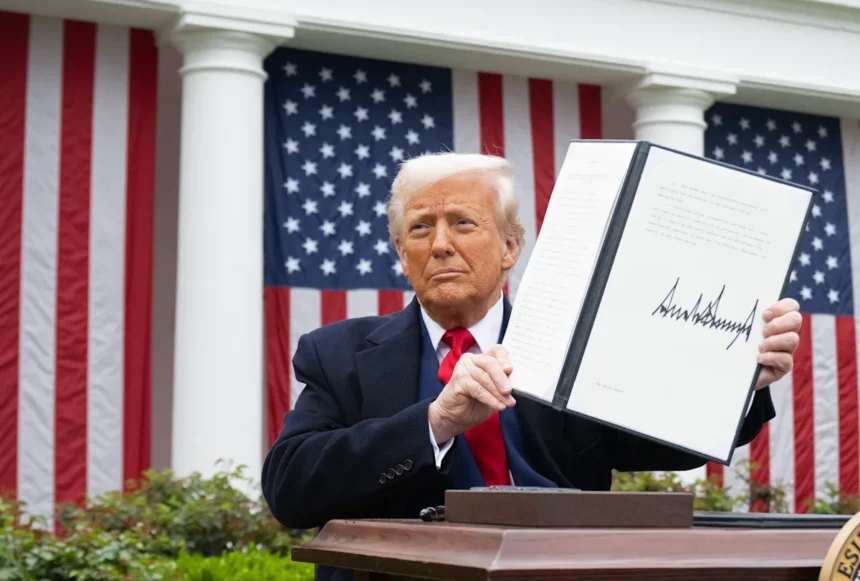
During a recent exchange with reporters in the Oval Office, President Trump acknowledged that U.S. consumers are “paying something” for the tariffs he has imposed. He commented, “I think that they might be paying something. But when you take the overall impact, the Americans are gaining tremendously.” This statement marks one of the first instances in which Trump has admitted that the costs associated with his tariff regime are ultimately borne by American consumers.
The recognition comes amid heightened scrutiny of these tariffs, particularly as they were examined by the U.S. Supreme Court this week. In a closely watched case, justices from both the liberal and conservative wings indicated skepticism about the president’s authority to enforce the sweeping tariffs that form a cornerstone of his economic strategy for his second term. Despite the court’s 6-3 conservative majority and its earlier support for the president in various decisions, the justices raised questions suggesting uncertainty about the legal basis for such tariffs.
Treasury Secretary Scott Bessent, who was present during the Supreme Court hearing, expressed optimism after the proceedings. However, should the court rule against Trump, it is anticipated that the administration would seek alternative paths to advance its trade agenda. Trump himself has emphasized the significance of the case, declaring it “literally LIFE OR DEATH for our country.”
In a related development, the U.S. and China recently reached a temporary trade truce. As part of this agreement, China has suspended additional export controls on rare earth metals and halted investigations into U.S. chip companies, while the U.S. will pause some of Trump’s “reciprocal tariffs” on China for the next year. On the heels of this truce, discussions continued regarding the suspension of punitive measures on China’s shipbuilding industry.
In a noteworthy move, China announced the introduction of a new rare earth licensing regime aimed at expediting shipments. Additionally, reports suggest that the White House has decided to block Nvidia from selling its latest scaled-down AI chip to China, effectively shutting the company out of that crucial market.
Trump also revealed a significant trade agreement with Uzbekistan, where the country is set to purchase and invest $35 billion in U.S. sectors over the next three years and more than $100 billion over the next decade.
Amid these complex dynamics, tensions regarding trade policies have extended to other nations as well. A dispute over a controversial ad featuring the late Ronald Reagan has led to diplomatic tensions between the U.S. and Canada, with the Canadian Prime Minister recently offering an apology to Trump.
As the debates surrounding tariffs continue, many analysts are closely monitoring the potential implications of the Supreme Court’s ruling. The high court’s skepticism regarding Trump’s authority could not only disrupt ongoing tariffs but also lead to a reevaluation of how trade policies are enforced in the future.
The uncertainty around Trump’s tariff regime has caused a stir among economists and trade analysts, who are preparing for possible outcomes that could reshape U.S. trade relations and economic landscapes. Observers expect that if the tariffs are overturned, there may be questions regarding potential refunds for revenues generated during this period.
As the administration navigates these challenges, Trump’s focus remains on using the legal avenues available to him while also attempting to solidify economic relationships both domestically and internationally.