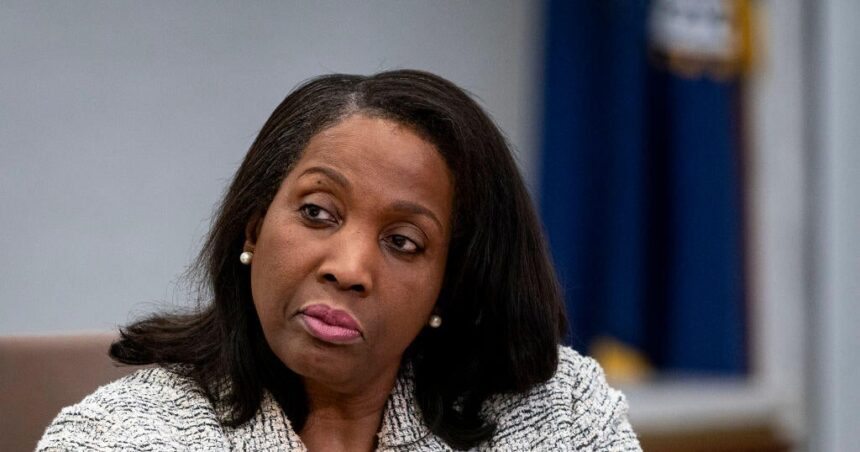
The Trump administration is appealing a federal ruling that has temporarily blocked President Trump’s attempt to dismiss Federal Reserve Governor Lisa Cook. This legal challenge comes just ahead of a significant meeting scheduled for next week, where Federal Reserve officials will deliberate on potential interest rate cuts.
Last month, President Trump moved to remove Cook from the Federal Reserve’s influential Board of Governors, accusing her of misrepresenting her residency in mortgage documents for two homes—one in Georgia and another in Michigan—when applying for loans. However, U.S. District Judge Jia Cobb intervened on Tuesday, determining that the president did not provide a legally valid reason for Cook’s dismissal. According to federal law, members of the Federal Reserve Board serve 14-year terms and can only be removed for justifiable reasons.
On Thursday, the administration filed a request with the U.S. Court of Appeals for the D.C. Circuit, seeking to suspend Cobb’s ruling while they proceed with their appeal. The Justice Department argued that the president retains substantial authority to dismiss federal officials and that the courts hold only minimal power to challenge such decisions. They contended that Cook’s alleged misconduct, which has yet to be conclusively explained by her, calls into question her trustworthiness and ability to responsibly manage the economy.
This controversy emerged following a communication from Bill Pulte, director of the Federal Housing Finance Agency and a Trump appointee. Pulte referenced mortgage documents that raised concerns about Cook’s financial dealings.
In response, Cook’s attorney, Abbe Lowell, dismissed the government’s allegations as “unsubstantiated and vague.”
The administration has urged the appeals court to make a decision by the end of the day on Monday, just prior to the Federal Open Market Committee’s meeting on Tuesday and Wednesday. This committee, which includes Cook, Federal Reserve Chair Jerome Powell, and ten other key officials, plays a crucial role in determining interest rate targets, which can significantly impact economic growth, inflation, and borrowing costs.
So far this year, the committee has maintained relatively high interest rates, though many investors and economists anticipate that a reduction in rates may be on the horizon in the upcoming meeting. While rate cuts could promote economic growth, they may also risk reigniting inflation.
Trump has been vocally critical of the Federal Reserve’s decisions to maintain steady rates, even giving Powell a derogatory nickname, “Mr. Too Late,” and asserting that the rate-setting committee should override the chair’s decisions. Powell’s term is set to expire in May.
The motion to remove Cook, who was appointed by President Biden and has a term that extends until 2038, comes in the broader context of Trump’s ongoing tensions with the Federal Reserve. Should Cook be removed, it would afford Trump the chance to appoint her successor, thereby enhancing his influence over the central banking system.