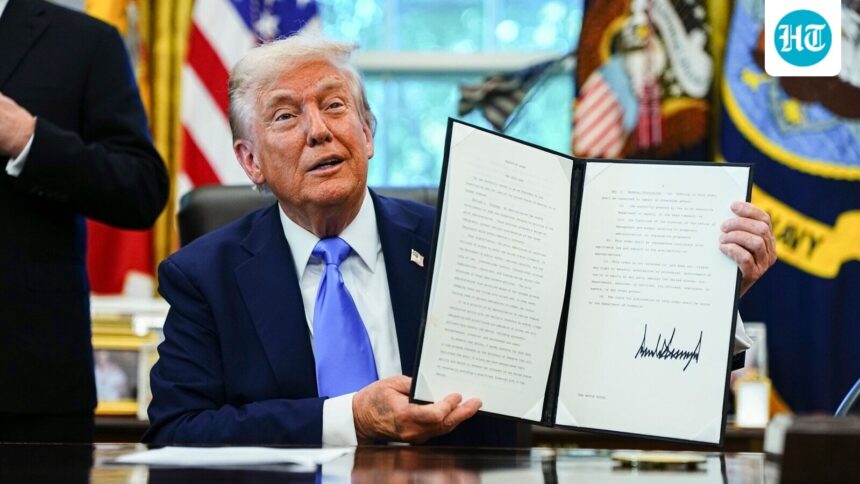
US President Donald Trump has announced a significant increase in the cost for companies wishing to secure H-1B visas for foreign employees, imposing a fee of $100,000. This decision was made public during a press briefing at the White House, where Commerce Secretary emphasized the administration’s goal of promoting the hiring of American talent and reducing the inflow of what they consider less valuable foreign workers.
The proclamation states that the new requirement will come into effect on September 21 and will remain in place for twelve months, with the possibility of extension. Trump has accused the current H-1B visa system of “systemic abuse,” particularly by IT outsourcing firms, labeling it a “national security threat.” He argued that the program has become a hindrance for American college graduates seeking IT jobs, as it allows employers to hire foreign workers at a significantly lower cost.
Given that a large percentage of H-1B visa holders are from India—accounting for over 70%—these new restrictions are expected to have a particularly adverse effect on the Indian workforce in the United States. Immigration lawyer Sophie Alcorn noted that for many Indian tech workers, the increased costs of job renewals and sponsorship could create barriers to employment, limiting job mobility and potentially forcing some to return to India or consider opportunities in countries like Canada, the UK, and the UAE.
Concerns have arisen amongst the Indian community regarding the uncertain future of their employment in the U.S. One H-1B visa holder expressed skepticism about the legal standing of the proclamation and anticipated challenges that may arise in the courts.
The H-1B visa program, established by Congress in 1990, permits U.S. companies to employ foreign workers in specialized roles requiring a minimum of a bachelor’s degree. The program currently caps annual visa numbers at 65,000, with an additional 20,000 available for individuals with advanced degrees from U.S. institutions. Throughout the years, Indian tech professionals have been among the largest recipients of these visas, driven by a persistent demand for specialized skills.
Political discourse around the H-1B program has grown tense, particularly as figures like Vice President JD Vance have criticized the practice of tech firms hiring foreign labor while simultaneously laying off American workers. Vance highlighted the inconsistency in tech companies applying for overseas work visas amid large-scale layoffs, indicating a disconnect that concerns many.
Director of U.S. Citizenship and Immigration Services (USCIS), Joseph Edlow, has signaled intentions to enforce stricter regulations regarding the H-1B program, stressing that it should serve to supplement the U.S. economy rather than replace American workers.
The topic of H-1B visas has led to division within Trump’s coalition, with notable conservative voices like Steve Bannon and Laura Loomer opposing the program. In contrast, Trump himself has defended it, underscoring its benefits in the past. He stated that he has utilized numerous H-1B visas within his businesses, reaffirming his belief in the program’s value.