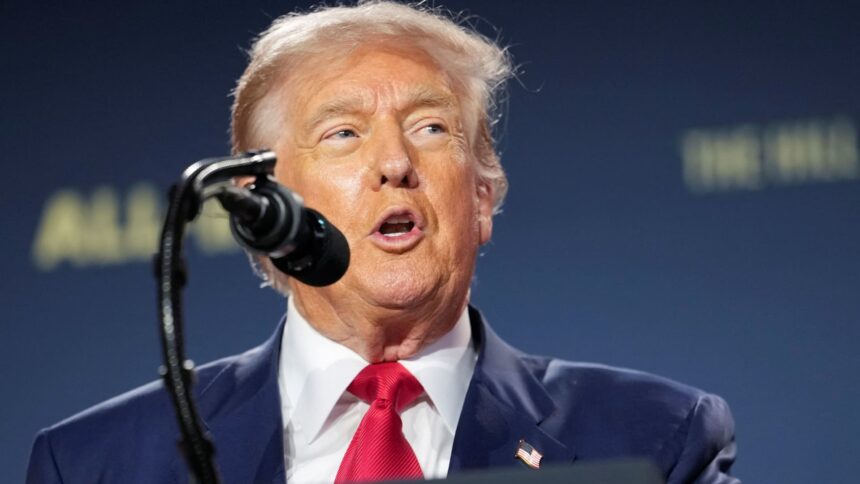
The Trump administration has unveiled a comprehensive legislative framework aimed at establishing a single national policy for artificial intelligence (AI) during a speech delivered by President Donald Trump at the “Winning the AI Race” Summit in Washington D.C. This strategic initiative is designed to impose uniform safety and security measures across the burgeoning AI sector while preventing individual states from enacting their own regulations.
The proposed six-pronged outline seeks to introduce a range of regulations for AI products and infrastructure. Key elements include new child-safety standards and uniform procedures for the permitting and energy consumption of AI data centers. Moreover, the framework emphasizes the need for Congress to tackle complex issues related to intellectual property rights and develop regulations to prevent AI technologies from being leveraged to suppress lawful political expression or dissent.
In a recent official announcement, the administration expressed its commitment to collaborating with Congress in the upcoming months to transform the framework into a tangible legislative bill that President Trump could approve. The White House aims to codify this framework into law within the current year, with hopes of garnering bipartisan support, as stated by Michael Kratsios, director of the White House Office of Science and Technology Policy, during an interview with Fox News.
However, achieving this goal may prove challenging in a Congress marked by deep divisions, where Republicans hold slender and often contentious majorities. Previously, Trump has urged GOP lawmakers to prioritize his contentious voter-ID bill as the midterm elections approach, complicating the legislative landscape. This week, the Senate has been embroiled in discussions surrounding the SAVE America Act, which currently lacks sufficient support to advance.
Amid escalating apprehensions regarding the implications of AI, several states—including New York and California—have moved to implement their own regulatory measures. AI industry leaders have pushed back against these state-level initiatives, warning that a fragmented legal framework could stifle innovation and place U.S. companies at a disadvantage against global competitors such as China.
In December, Trump signed an executive order advocating for a standardized national regulatory framework for AI, underscoring the administration’s commitment to preempt state laws that create excessive burdens. The White House maintains that a singular national standard, aligned with its recommendations, is essential to foster innovation without fragmentation.
In his Friday press release, Kratsios asserted that the new national AI legislative framework is poised to “unleash American ingenuity to win the global AI race,” promising potential job creation, cost reduction, and improved quality of life for citizens. The framework also aims to address significant concerns, including online safety for children, rising energy costs, intellectual property rights, and support for American workers, thereby ensuring that all citizens can trust and benefit from this transformative technology.