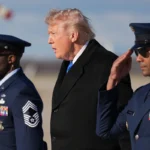
In a bid to sway voter sentiment amid declining approval ratings, President Donald Trump addressed a crowd in Mount Pocono, Pennsylvania, claiming that economic hardships faced by everyday Americans are not his doing. His remarks came against a backdrop of growing public discontent regarding inflation and rising living costs, issues that have increasingly colored perceptions of his administration nearly a year into its second term.
Trump’s speech, his first rally-style event since the summer, was marked by assertions regarding job creation in Pennsylvania, which he backed with unverifiable statistics. He then pivoted to his administration’s recent announcement of a $12 billion bailout aimed at supporting farmers impacted by low crop prices and high tariffs. While he expressed optimism regarding the farmers’ reception of the aid, it was revealed that the funding would draw from the Commodity Credit Corporation, an agency that often relies on loans from the U.S. Treasury.
Throughout his address, Trump employed his characteristic off-the-cuff style, interweaving scripted lines with personal anecdotes in a bid to reconnect with working-class supporters. He claimed credit for a significant drop in prices, attributing this to his administration’s increased oil exploration and promotion of economic growth. Dismissing concerns over inflation as a “hoax” perpetuated by Democrats, Trump insisted that “the only thing” that continues to rise is the stock market and Americans’ 401(k) valuations.
The president launched sharp criticisms at Democrats, equating their discourse on affordability to “Bonnie and Clyde preaching about public safety,” and labeled them as detrimental to the working class. He accused President Biden and his administration of exacerbating economic challenges, claiming they were responsible for soaring prices, while simultaneously presenting himself as the solution.
The rally took a controversial turn when Trump made unfounded claims regarding the legitimacy of Biden’s appointees to the Federal Reserve, alleging that their commissions may have been signed by an autopen. This conspiracy theory echoed longstanding tensions between the president and the central bank’s leadership.
As Trump attempted to rally support, the Senate was poised to vote on legislation that could extend pandemic-era health insurance subsidies, suggesting a crucial intersection of economic policy and electoral interests. Trump, however, distanced himself from the proposed measures, arguing that they financially benefited insurance companies rather than providing relief to American families.
Voter sentiment, as captured in recent polling, reflects deepening dissatisfaction with the economy under Trump’s leadership. A Gallup poll indicated that only 36 percent of voters approved of his presidency, while a Politico survey found that nearly half of respondents associated the current economic challenges with his policies, indicating a significant disconnect between Trump’s narrative and public perception.
Despite his claims of economic success, the reality remains that American families are grappling with price increases attributed to the tariffs he instituted on imported goods. While Trump defended these tariffs as essential for protecting American manufacturing, the burden of higher consumer prices continues to weigh heavily on voters’ minds.
As Trump returns to convening large rallies, the implications of his messaging on economic issues come at a pivotal moment in U.S. politics, suggesting that he is aware of the necessity to regain favor with constituents who feel the economic pinch.