US President Donald Trump characterized the ongoing conflict with Iran as nearing its conclusion, asserting that the US has “nearly achieved its military goals.” Trump suggested that American forces could withdraw from Iran within two to three weeks, sparking hopes for a potential resolution. However, he tempered this optimism by warning of a looming escalation, stating that the US would respond to any Iranian actions with significant force. He notably remarked that Iran might be “brought back to the stone ages where they belong,” leaving the timeline for resolution ambiguous.
The situation is further complicated by Trump’s comments regarding the near-closure of the Strait of Hormuz, a critical corridor for global oil shipments. He called upon allies reliant on Middle Eastern oil to assist in resolving the standoff, predicting that the passage would naturally reopen as hostilities diminish. Trump also claimed that Iran had requested a ceasefire, a statement that Tehran promptly rejected as “false and baseless.”
As the geopolitical tension continued, global investor sentiment swung wildly. In India, the stock market initially plummeted, with the BSE Sensex dropping over 1,500 points before recovering slightly, closing up by 185.23 points. Meanwhile, the NSE Nifty saw a smaller decline, ending with a marginal gain. This rebound was predominantly attributed to renewed interest in major IT stocks, although many industry heavyweights faced significant pressure.
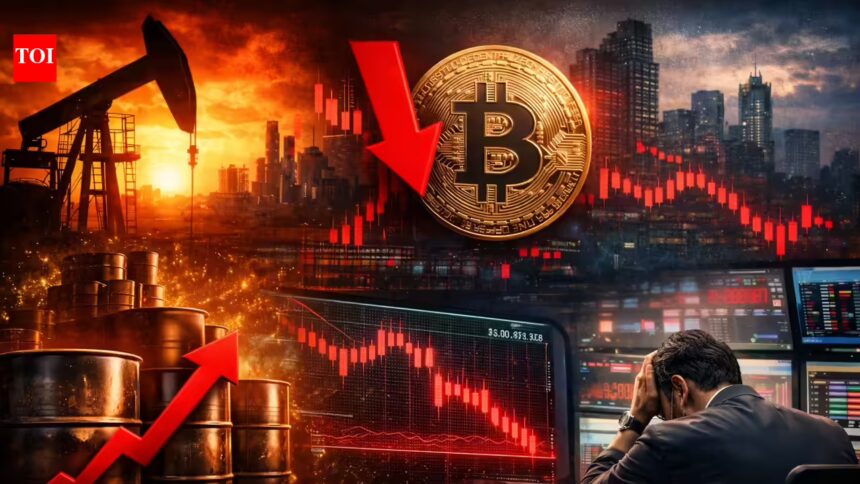
The impact of the conflict on energy markets was profound, as oil prices surged sharply. Brent crude increased by 6.6%, nearing $108 a barrel, driven by fears of sustained disruptions in oil supplies from the Strait of Hormuz. The effective closure of this waterway intensified concerns over global supply constraints and heightened inflation pressures linked to escalating energy costs.
Countries like Nepal and Bhutan, heavily dependent on fuel imports, were feeling the pinch from rising prices. Nepal reported nearly doubling aviation fuel prices, jeopardizing its tourism-dependent economy, while Bhutan faced similar challenges, citing external factors for increasing costs in a nation that, despite its carbon-negative status, relies on fuel imports from India.
In the precious metals market, prices fell sharply following Trump’s address. Spot gold tumbled by over 4%, snapping a winning streak, while silver faced even steeper declines. The rising volatility and uncertainty prompted investors to liquidate positions, diminishing the traditional safe-haven appeal of gold.
Cryptocurrencies also felt the strain, with Bitcoin and other major tokens declining as market players pulled back from risk-sensitive assets. Bitcoin dropped to around $66,600, hindered by negative sentiment as the trajectory of the conflict remained uncertain.
Globally, stock markets reflected weak investor sentiment, with major European indexes opening lower and Asian stocks declining in response to rising fuel prices and geopolitical tensions. Japan’s Nikkei 225 and South Korea’s Kospi experienced significant drops, further magnifying concerns over the economic implications of the ongoing conflict and its effects on global markets.