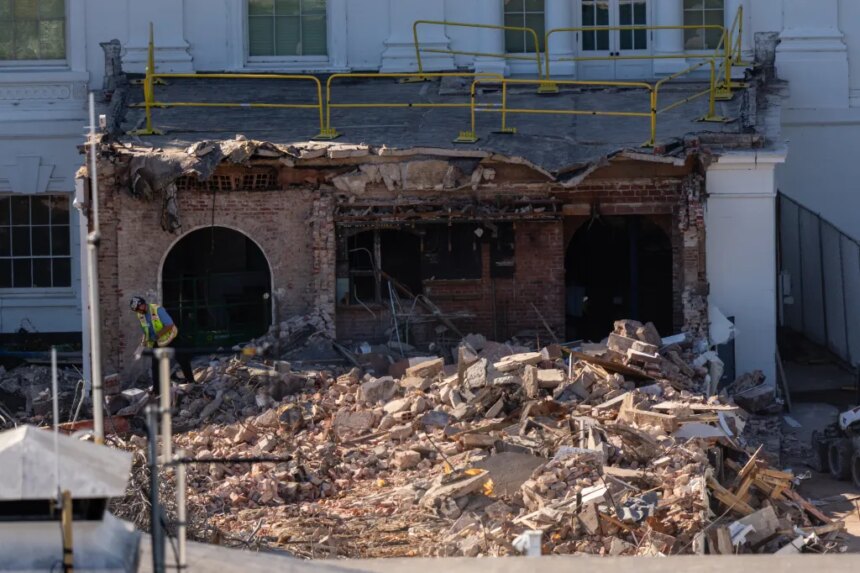
Outside the White House, a palpable sense of tension filled the air as a woman, clutching a sign emblazoned with the word “Geneva,” repeatedly shouted, “The demolition is illegal! The demolition is a federal crime.” This dramatic scene unfolded amid the noise of heavy construction equipment laboring to dismantle one of the most historically significant structures in the United States.
Inside, the White House briefing room was a contrast of poise and controversy as Press Secretary Karoline Leavitt staunchly defended Donald Trump’s decision to demolish the East Wing, asserting the legality of the actions taken. When pressed by a reporter about the implications of such power, Leavitt’s response implied an open-ended authority—suggesting that Trump could, theoretically, “tear down whatever he wants.”
The construction sounds echoing through the complex have put the administration on the defensive. Following widespread criticism from preservation groups and various political quarters, Trump’s team has scrambled to draw parallels with past renovation efforts and emphasize a vision for the future—namely, a $300 million, 90,000 square-foot ballroom. Leavitt described this new structure as a “big, beautiful ballroom” intended for grand state affairs and celebrations for generations to come. However, critics argue that such changes threaten the White House’s historic character and integrity.
Concerns have grown regarding the abrupt nature of the demolition process, marked by a conspicuous lack of public input and oversight from congressional bodies or preservation commissions. Organizations like the National Trust for Historic Preservation have raised alarms about the drastic alterations to the East Wing and surrounding areas, warning that the new ballroom’s scale could disrupt the White House’s carefully curated classical design.
According to plans revealed, the demolition has gone far beyond mere construction updates. The removal of the East Wing is complemented by the dismantling of the East Colonnade corridor, negating the existing architectural flow. Furthermore, Trump has indicated that parts of the East Room will also be repurposed to create a new connection to the ballroom—nuances that had not been publicly disclosed prior to the demolition.
When questioned on why Trump did not clarify these extensive plans initially, Leavitt invoked the unpredictability typical of construction projects, urging the public to “Trust the process.”
The East Wing, though less celebrated than its more prominent counterpart, the West Wing, has long served as a space for First Ladies and their initiatives. Since its inception by Theodore Roosevelt in 1902 and a considerable expansion by Franklin D. Roosevelt in the 1940s, the East Wing has housed numerous significant offices and even a bunker for emergencies.
In recent years, it has hosted various social, cultural, and political activities, becoming a familiar setting for visitors and citizens alike. It provided tranquility amid the often-raucous atmosphere of the West Wing, with windows overlooking the Jacqueline Kennedy Garden—a quiet highlight now threatened by ongoing demolition efforts.
Accompanying the East Wing was the East Colonnade, a naturally lit passageway that included the White House Family Theater, a historical venue for cultural screenings attended by both First Families and notable filmmakers. The cultural legacy tied to this space, from Eisenhower to Obama, speaks to the intimate interactions that have taken place within its walls.
As construction of the ballroom continues, the essence of the East Wing and the subtle charm of the White House may be irrevocably altered. Critics lament that the planned opulence of the new ballroom, characterized by arched windows and lavish decor, stands in stark contrast to the understated dignity that has long defined the People’s House.
Trump himself expressed sentiments downplaying the East Wing’s significance, dismissing it as “never thought of being much” while championing the new ballroom as a hallmark of beauty and grandeur.
Former White House photographer David Hume Kennerly poignantly reflected on the developments, sharing a quote from Betty Ford: “If the West Wing is the mind of the nation, the East Wing is the heart.” His words underscore the broader implications of these demolitions—many view this action not merely as the removal of a building, but as a symbolic severance from a deeper historical and emotional legacy.