








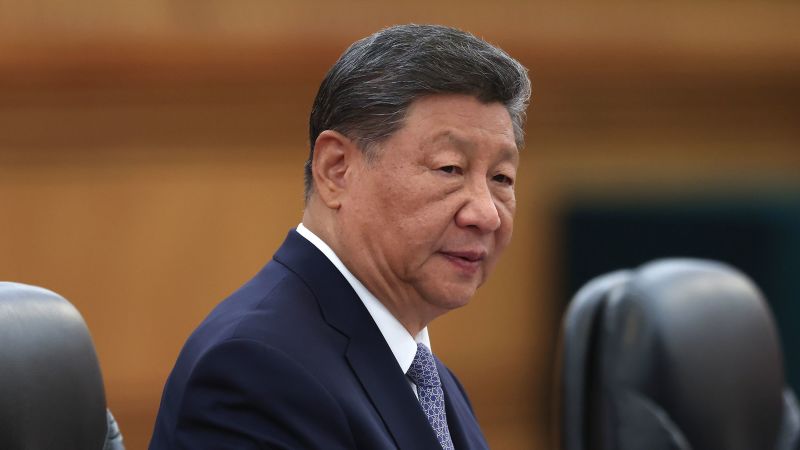
In a significant escalation of tensions between the United States and China, former President Donald Trump criticized Chinese President Xi Jinping over new restrictions on rare earth exports imposed by Beijing. This move has raised fears of economic retaliation and has led Trump to question the necessity of an upcoming meeting scheduled for later this month during the APEC summit in South Korea.
In a post on social media platform Truth Social, Trump expressed alarm at what he termed “very strange things” happening in China. He criticized the country’s “hostile” approach and its intent to impose export controls on a wide array of materials essential for various industries, including technology and defense. According to Trump, these measures could disrupt global markets and complicate economic relations, particularly for nations reliant on rare earth elements, of which China currently holds a significant monopoly.
He issued a stern warning of potential financial countermeasures against China, declaring: “Dependent on what China says about the hostile ‘order’ that they have just put out, I will be forced… to financially counter their move.” Trump also pointed out that while China has dominated certain rare earth markets, the U.S. has robust alternatives, stating, “For every Element that they have been able to monopolize, we have two.”
The Chinese government’s export restrictions represent a calculated effort to gain leverage in trade negotiations with the United States, particularly as both nations remain engaged in ongoing discussions over economic policies. The measures announced included expanded controls over minerals critical for military applications and semiconductor production, deliberately targeting a vulnerability for the U.S. This prompted alarm within the Trump administration, with many identifying this as an attempt by Xi to secure an advantageous position before their planned meeting.
The possibility of a cancellation of this meeting adds a layer of uncertainty to U.S.-China relations. Trump indicated a lack of interest in the meeting due to the unexpected nature of China’s export controls. “I was to meet President Xi in two weeks… but now there seems to be no reason to do so,” he stated.
White House sources have characterized China’s recent actions as an escalation that could jeopardize any constructive dialogue, though it remains unclear whether Trump’s meeting with Xi will officially be canceled. Meanwhile, concerns within the administration have grown about how the new U.S. export controls on Chinese firms could have prompted this aggressive stance from Beijing.
Moreover, Trump criticized the timing of China’s announcement, suggesting it detracted from his diplomatic efforts elsewhere, notably relating to peace negotiations in the Middle East. He noted that the Chinese communication on export restrictions occurred on the same day as a significant peace deal, implying intentional provocation.
In response to the potential economic fallout, Trump has initiated strategies aimed at bolstering U.S. rare earth production. This includes recent financial commitments, such as a $400 million equity stake in MP Materials Corp, the only significant U.S. rare earth producer. Despite these efforts, officials acknowledge that developing a resilient domestic supply chain will take time, leaving the U.S. at continued risk of dependency on China.
The escalating rhetoric has begun to impact markets, with Wall Street reacting negatively to Trump’s statements. Following his social media post, the Dow Jones Industrial Average fell by 550 points, sparking fears of a renewed trade war that could threaten economic stability as the holiday season approaches.
As the situation unfolds, both nations have intensified scrutiny over each other’s key industries, complicating the landscape of international trade. The U.S. has imposed heightened export controls on various sectors, while trade tensions continue to mount, reflecting the underlying anxieties surrounding reliance on China’s dominance in critical resources. This ongoing saga serves as a reminder of the precarious balance between diplomacy and economic competition in the current global landscape.