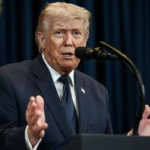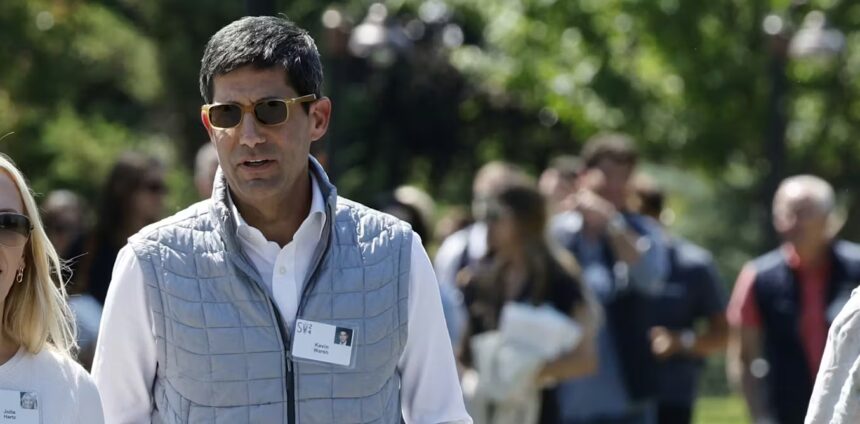
In a pivotal move that has set off ripples across the financial landscape, US President Donald Trump has confirmed his intention to nominate Kevin Warsh as the next chair of the US Federal Reserve. This announcement is particularly significant given the backdrop of Trump’s tumultuous relationship with the Fed, especially with its current chairman, Jerome Powell.
Immediately following the confirmation, the gold and silver markets experienced a sharp downturn. Gold prices plummeted by 9%, while silver fell even more dramatically by 28%. This decline marked a significant departure from recent months, during which these precious metals had reached record highs amid heightened economic uncertainty. Concurrently, the US stock market also took a hit, with major indices reflecting modest losses.
Interestingly, this market response can be interpreted as an initial endorsement of Warsh’s potential independence and suitability for the role, despite widespread concerns about Trump’s potential interference with the Federal Reserve.
The backdrop of this development showcases Trump’s long-standing friction with the Federal Reserve. After appointing Powell in 2017, relations quickly soured when Powell resisted Trump’s calls for rapid interest rate cuts. Trump’s criticism of Powell has been unrestrained, branding him a “clown” and expressing a desire to dismiss him outright. This conflict escalated to the point where Trump’s Justice Department launched investigations into both Powell and another Federal Reserve governor, Lisa Cook, citing questionable allegations linked to their conduct. However, these accusations have been largely dismissed as baseless and are currently under legal scrutiny.
In response, Powell has stood firm, emphasizing that the Fed’s decision-making should reflect the broader economic priorities rather than the immediate preferences of the President. He has garnered support from 14 international central bank leaders, who underscored the essential nature of central bank independence for maintaining economic stability. Historically, interference with the Federal Reserve has led to serious economic downturns, including the stagflation crisis of the 1970s, making the independence of the Fed a critical issue for the global economy.
Warsh emerges as a candidate with a prominent background as a former banker and Federal Reserve governor. He has previously served as an economic advisor to both President George W. Bush and Trump. Initially, Trump appeared inclined to nominate Kevin Hassett for the position, but Hassett was considered too closely aligned with Trump’s views, raising alarm bells about the potential erosion of Fed independence. Warsh’s reputation as an inflation “hawk” distinguishes him from others and occurs within a broader discussion about managing the delicate balance between economic growth and inflation control.
As an inflation hawk, Warsh has historically prioritized combating inflation, contrasting with the dovish stance that favors growth and employment. Despite this, he has shown signs of moderating his views in recent times, echoing Trump’s criticisms of the Fed and advocating for lower interest rates. This raises questions about whether Warsh’s commitment to inflation control will persist or if he will align himself more closely with Trump’s economic agenda.
Market reactions to the nomination signal a potential shift in investor sentiment about future interest rate cuts under Warsh’s leadership. The significant decline in gold and silver prices suggests that investors may foresee a more stable financial environment with lower inflation expectations, aligning with a broader perception of reduced Fed independence risks.
Warsh’s appointment could have notable implications for the credibility of the Federal Reserve and the US dollar, which remains a cornerstone of American economic dominance. As Trump navigates his complex relationship with monetary policy, the ability to balance political influences with the integrity of the Federal Reserve may be crucial for the future of the US economy. The extent to which Warsh can maintain this balance and secure the Fed’s independence remains to be seen, as both political dynamics and market responses evolve in the wake of this significant nomination.