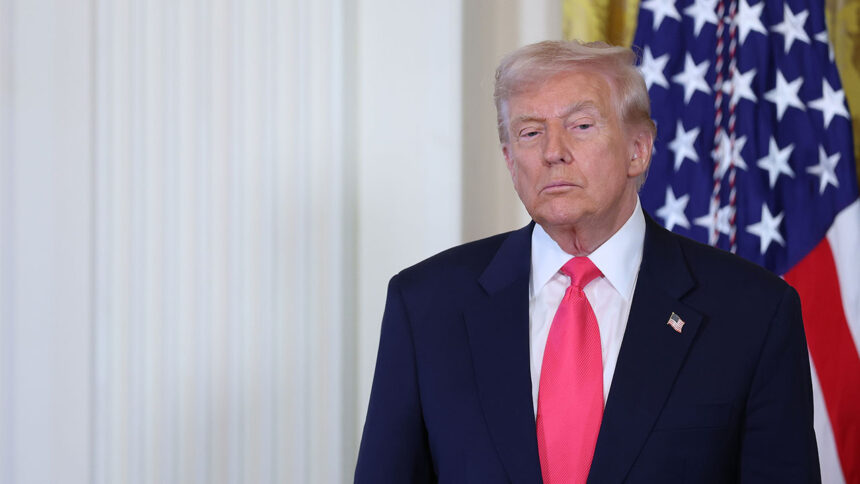
In recent remarks, former President Donald Trump expressed a bold prediction regarding the Dow Jones Industrial Average, suggesting it could reach an unprecedented 100,000 by the time he concludes his term in January 2029. This statement follows the Dow’s recent milestone of surpassing 50,000 for the first time, which occurred last Friday.
On his Truth Social platform, Trump attributed both the record stock market performance and national security improvements to his tariff policies, reiterating his belief in their effectiveness: “Record Stock Market, and National Security, driven by our Great TARIFFS.” He also urged the U.S. Supreme Court to pay attention to his assertions, as a critical case regarding the constitutionality of his tariff authority is currently under review.
This case has garnered significant attention following recent arguments before the Supreme Court, where the legality of Trump’s broad tariff powers is being examined. Economists have pointed out that the economic impacts of the tariffs have predominantly fallen on American consumers and businesses, rather than the foreign exporters that the tariffs were targeted at. A study conducted by the Kiel Institute for the World Economy revealed that approximately 96% of the tariff expenses have been shouldered by Americans.
On the same platform, Trump revisited his performance regarding the stock market, highlighting that experts had initially set the bar at 50,000 Dow points by the end of his term. He claimed to have achieved this milestone three years ahead of schedule, leveraging this achievement for his political narrative: “Remember that for the Midterms, because the Democrats will CRASH the Economy!”
In a lighter note, he also took a moment to send well wishes to the nation ahead of the Super Bowl, asserting that the United States is “stronger, bigger, and better than ever” and proclaiming that “the BEST IS YET TO COME!”
As these developments unfold, the intersection of economic performance, legal challenges to tariffs, and upcoming political events is set to shape the national discourse in the months leading up to the next election cycle.