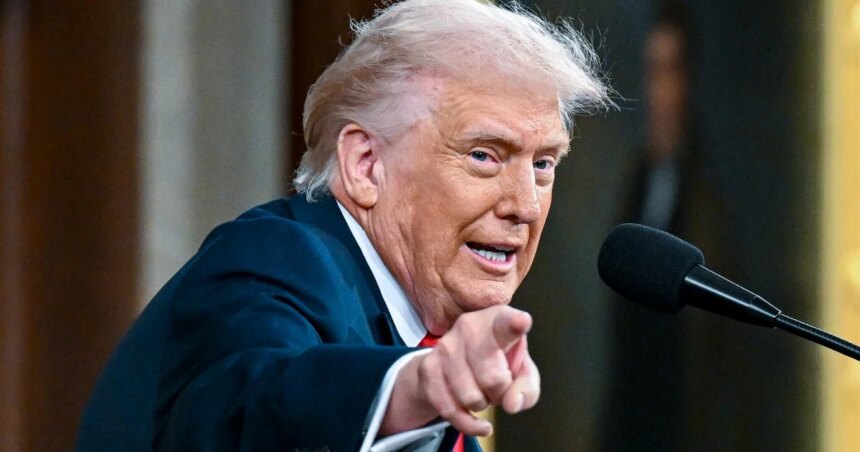
During a recent State of the Union address, President Trump outlined an ambitious plan aimed at addressing what he termed a “gross disparity” within America’s retirement system. Approximately 56 million Americans currently lack access to employer-sponsored savings plans, prompting the president’s call for action. “Half of all working Americans still do not have access to a retirement plan with matching contributions from an employer,” he stated, underscoring the significant obstacles many face in securing their financial futures.
The proposed initiative seeks to leverage the structure of the Thrift Savings Plan, typically available to federal employees, to assist American workers. Under this plan, the federal government would provide up to $1,000 per year in matching contributions to individual retirement accounts. This measure aims to help those excluded from traditional retirement options, such as 401(k) plans, particularly after a report from the National Institute on Retirement Security highlighted that individuals without employer-sponsored plans are often disinclined to save for retirement.
Emphasizing the urgency of the issue, Trump noted how the balance of the typical 401(k) has increased by roughly $30,000 since he took office, revealing a stark contrast for those without access to such plans. The new accounts would be portable, allowing workers to retain their savings even as they transition between jobs, thus enhancing flexibility. Additionally, private philanthropists would be able to contribute to these accounts, further increasing their potential growth.
Experts have commended the initiative as a substantial move towards resolving the persistent lack of retirement savings for low-income Americans. Teresa Ghilarducci, a retirement researcher, remarked that the plan could be the most meaningful legislative effort in decades to boost contributions to the retirement accounts of lower-income workers. The framework is reportedly aligned with earlier legislation known as the Secure Act 2.0, signed into law by President Biden, which also includes a matching contribution incentive for low- to moderate-income employees.
Despite the optimism surrounding the new plan, challenges remain, particularly for those in the lowest income brackets. Research indicates that nearly 79% of full-time workers earning below $27,400 annually do not have access to retirement plans. Conversely, among those with retirement savings, the median balance is only $40,000—far below the approximately $1.5 million that many believe is necessary for a comfortable retirement.
Financial analysts have pointed out both the potential benefits and limitations of this new strategy. While the proposal is seen as a step forward, some believe that many low-income workers may not fully engage with the new accounts. Ghilarducci anticipates that only around half of these workers might open an account, constrained by immediate financial pressures such as debt.
Concerns have also been raised regarding the funding of Trump’s initiative, with critics questioning the sustainability and efficacy of providing taxpayer-funded match contributions. Some experts suggest that a more straightforward solution could emerge through universal savings accounts, emphasizing simplicity over additional tax-advantaged options.
In summary, while President Trump’s retirement initiative signals potential progress in expanding access to savings plans, significant obstacles remain. Whether this plan can effectively bridge the extensive gap in retirement savings for millions of Americans is yet to be determined, as stakeholders await further details on its implementation and impact.