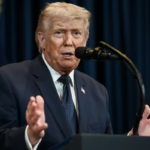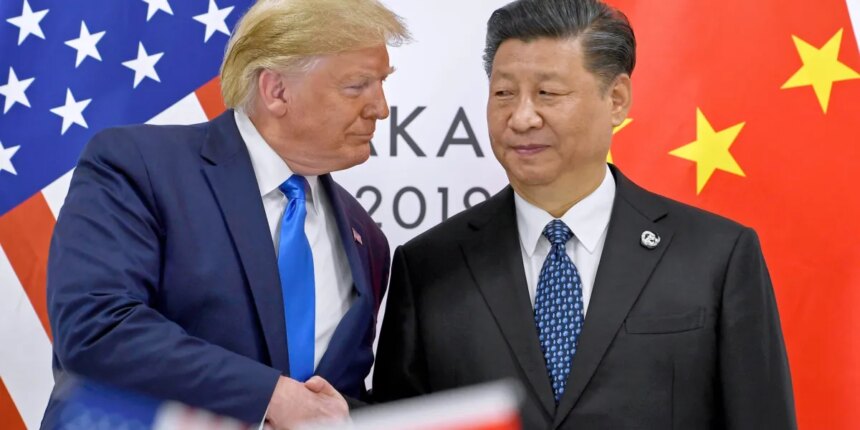
President Donald Trump stated on Friday that there appears to be no compelling reason to meet with Chinese leader Xi Jinping during his upcoming trip to South Korea. His comments came on the heels of China implementing new restrictions on the export of rare earth elements crucial for various American industries, which has heightened tensions between the two nations.
Trump’s remarks suggested that he is considering a “massive increase” in tariffs on Chinese imports as a retaliatory measure against these restrictions. He indicated that the United States might explore several countermeasures as part of its response. The president expressed his intentions on the Truth Social platform, highlighting that discussions regarding heightened tariffs on Chinese products are currently taking place within his administration.
The ongoing trade negotiations between the U.S. and China have been marked by episodes of tense exchanges, particularly following the introduction of tariffs earlier this year that effectively ignited a trade war between the two largest economies in the world. While both nations had previously agreed to de-escalate tariffs after negotiations in Switzerland and the United Kingdom, the recent developments have reignited fears of a deteriorating economic relationship. China’s limitations on exports of rare earths, which are integral to modern technologies, have only exacerbated these tensions.
Trump noted that while a meeting with Xi was initially planned for his trip at the end of the month—which includes stops in Malaysia and Japan—he no longer sees justification for such a discussion. The potential meeting was considered significant as it would precede the Asia-Pacific Economic Cooperation (APEC) summit.
The president’s latest statements coincided with a decline in the stock market, with the S&P 500 dropping by as much as 2%, reflecting investors’ concerns about escalating tensions between the U.S. and China.
China’s new export restrictions, announced just a day prior, mandate that foreign companies obtain special approval for shipping rare earths, along with additional permitting requirements on related technologies. The Chinese government has made it clear that any export requests for materials used in military applications will be denied.
In response to these developments, Trump expressed that China is becoming increasingly hostile and accused it of holding the global community “captive” through its control over essential materials such as metals and magnets used in various high-tech products.
Accompanying his accusations, Trump voiced skepticism regarding the timing of China’s announcements, suggesting that they aimed to undermine his diplomatic efforts regarding a ceasefire between Israel and Hamas in Gaza. He raised the possibility that the announcement may have been a deliberate distraction from his role in securing peace in the region.
Experts are voicing concerns about the implications of the trade war on the global supply chain for rare earth elements. Gracelin Baskaran from the Center for Strategic and International Studies highlighted that China wields significant leverage in this sector, controlling a substantial portion of global production, which complicates U.S. efforts to build its industrial base and strengthen military capabilities.
Historically, the trade conflict has seen the U.S. imposing steep tariffs on Chinese goods, which led to a reciprocal response from China. Though negotiations in the past had resulted in reduced tariff rates, underlying issues remain, particularly regarding rare earth access and restrictions on U.S. high-tech exports.
Trump’s recent statements signal a potential shift back to escalating trade tensions, drawing commentary from analysts who highlight both nations’ hesitance to de-escalate. Some suggest that Trump’s threats may be a strategic maneuver to regain leverage, while others warn of the dangerous cycle of mutual economic disruption that both sides are apparently unwilling to halt.
As the situation develops, it remains uncertain how Trump intends to implement his threats and how China will respond to this renewed aggression. Concerns over a potential breakdown in negotiations loom as the two countries continue to reach for economic “weapons.”