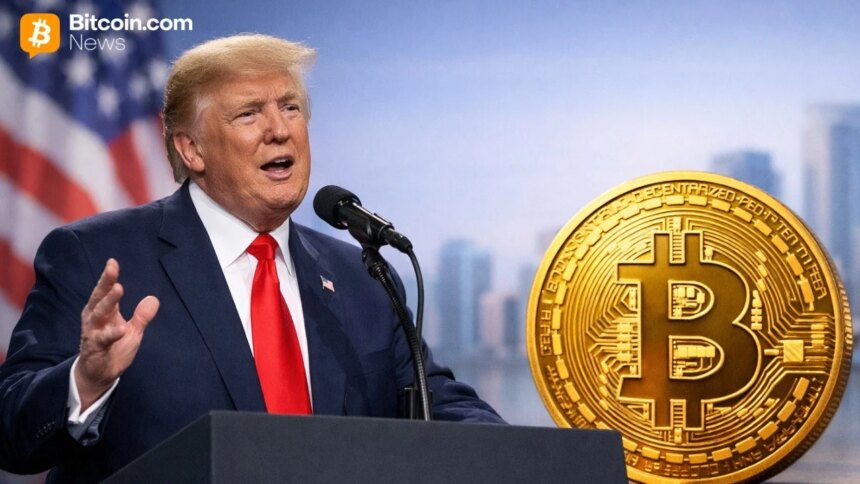
A pronounced shift in the U.S. approach toward digital assets unfolded as President Donald Trump addressed the Future Investment Initiative Summit in Miami. In his remarks, he underscored the nation’s intent to position itself at the forefront of Bitcoin adoption and the overall expansion of the cryptocurrency market.
“My administration has also worked tirelessly to ensure that America remains at the bleeding edge of the crypto revolution,” he stated, claiming that a lack of proactive measures would allow China to dominate the sector. Trump made it clear that the U.S. aims to be the “undisputed crypto capital and Bitcoin superpower of the world,” highlighting the growing demand for cryptocurrency transactions. “So many people, now, they want to pay you in crypto. They want to pay you in bitcoin, and we have to be at the top of it in all of these—call it an industry,” he emphasized.
Trump also referenced the legislative groundwork laid during his administration, specifically mentioning the Genius Act, which established a straightforward framework for dollar-backed stablecoins. This legislation, he asserted, marked a significant achievement, and he voiced determination not to allow opposition from political rivals to obstruct progress in the sector. He acknowledged the bipartisan interest in cryptocurrencies, noting, “Although they’ve had a lot of support for crypto … the Democrats have been very strong on crypto.”
On the regulatory front, a key development linked to Trump’s address was the joint interpretations issued by the U.S. Securities and Exchange Commission (SEC) and Commodity Futures Trading Commission (CFTC). These guidelines classified multiple digital assets, such as Bitcoin, Ether, and XRP, as digital commodities. This shift marked a move away from enforcement-led actions, offering a clearer framework aligned with the Genius Act for stablecoin issuance and compliance.
Trump articulated a broader vision for regulatory clarity, advocating against excessive regulations and restrictions. “We want to have free enterprise, open,” he asserted, crediting America’s status as the world’s financial capital to its strength and freedom. The Trump administration aims to maintain that environment.
Expanding the discussion beyond cryptocurrencies, Trump addressed the importance of artificial intelligence and advanced manufacturing in a comprehensive economic agenda designed to attract over $2.7 trillion in technology investments. This initiative aims to intertwine innovation-led growth with the expansion of financial market infrastructure.
In closing, Trump emphasized accessibility in governance, inviting individuals with concerns to reach out directly. “And I tell people, if you have problems, call me. Call me. And some of them are amazed. I actually take their call and get their problem solved,” he claimed. This approach reflects a commitment to being more engaged with the technological and financial challenges facing constituents.
In summary, Trump’s address signals a clear agenda to bolster the U.S. role in the cryptocurrency landscape through supportive regulation and a focus on technological advancement, framing it as an essential component of the nation’s future economic strategy.