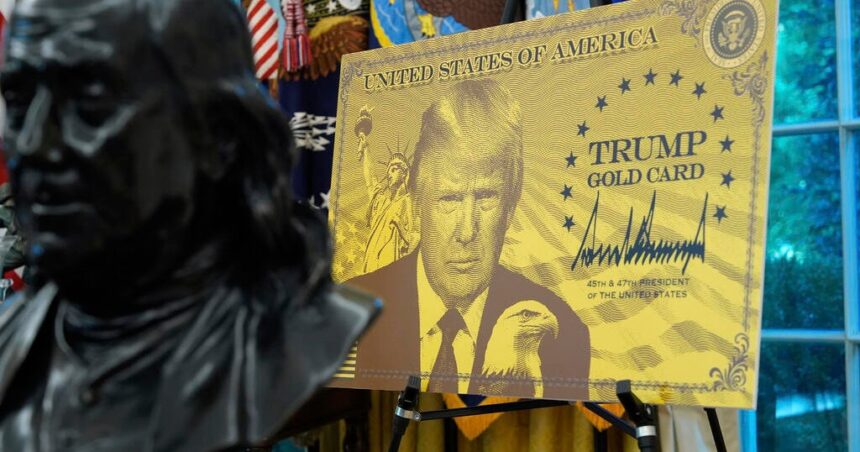
In a significant policy shift, President Trump has signed an executive order establishing a new “Gold Card” visa program aimed at attracting high-investment immigrants willing to contribute at least $1 million to the U.S. economy. The official announcement was made on a government website featuring a mock-up of the Gold Card, which prominently displays Trump’s image alongside national symbols such as the bald eagle and the Statue of Liberty, with the slogan “Unlock life in America.”
The Gold Card initiative, first introduced by Trump in February, outlines that individuals willing to make a substantial donation to the Commerce Department will be eligible for an expedited immigrant visa process. Corporations can play a role in this program by sponsoring individuals, requiring a minimum contribution of $2 million to the government. Commerce Secretary Howard Lutnick confirmed that approximately 80,000 Gold Cards will be issued, although the program is currently in its “implementation phase.”
Individuals who successfully navigate the vetting process conducted by the State Department and Department of Homeland Security, and pay a $15,000 “vetting fee,” will acquire lawful permanent residency, commonly referred to as a green card. Lutnick emphasized that this new Gold Card will replace existing EB-1 and EB-2 visa programs, which cater to applicants demonstrating “exceptional ability” in various fields.
Lutnick articulated a clear expectation: “You can prove exceptional value for the United States of America by contributing $1 million. That’s a pretty good expectation that they’re highly valuable.” He further indicated that other visa categories could be suspended soon, transitioning to the new Gold Card model.
In addition, the administration is contemplating the introduction of a “Platinum Card,” priced at $5 million, which would allow holders to spend up to 270 days in the U.S. without paying taxes on non-U.S. income. However, this program would not provide a pathway to citizenship and still requires Congressional approval.
The same day, Trump issued another executive order that imposes a $100,000 fee on individuals seeking to enter the U.S. through the H-1B visa program, a non-immigrant visa widely utilized by tech companies to employ foreign workers. This fee could represent a significant tightening of the existing H-1B framework. Critics have long argued that the H-1B program enables employers to hire foreign talent at lower wages, potentially undermining American workers. Conversely, supporters claim that this program is vital for tech companies facing shortages of qualified domestic candidates.
In response to concerns regarding the newly imposed H-1B fee, Trump expressed optimism, suggesting that tech companies would largely approve of the changes. “I think they’re going to be very happy,” he said, adding that the adjustments would ensure that “productive people” can be retained in the country while generating substantial revenue through the new fees.
As the administration moves forward with these initiatives, the implications for both immigration policies and the labor market will be closely monitored by stakeholders across the economic spectrum.