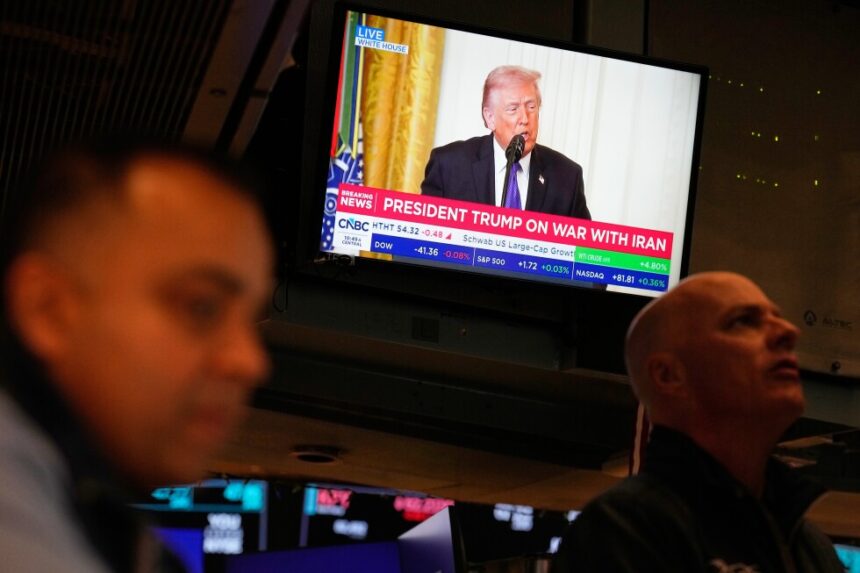
As the conflict in Iran escalates, President Donald Trump is focusing on stabilizing the financial markets to prevent a sharp increase in oil prices, significant stock market declines, and rising interest rates. With the harsh realities of the economic consequences looming, Trump has been quick to use social media to project confidence about the situation, claiming that the markets are healthier than he had anticipated, despite the S&P 500 seeing a five-week downturn and oil prices rising around 60%.
During an investor summit, Trump remarked, “I thought oil prices were going to go up higher than they are now,” and expressed surprise at the resilience of stock performance. Despite these optimistic statements, the ongoing conflict has created a precarious environment for global energy supply, leading the White House to adopt a less aggressive messaging strategy regarding the economic fallout and a greater focus on managing market volatility.
Ahead of the stock market opening on a recent Monday, Trump characterized the peace talks with Iran as making “great progress,” even as he simultaneously issued a warning regarding potential military actions against civilian infrastructure if a resolution is not reached soon. This juxtaposition of messages reflects the Administration’s efforts to utilize stock, energy, and bond markets as indirect communication channels to reach the American public, reinforcing Trump’s agenda of promoting lower fuel prices, growing retirement savings, and affordable mortgage interests.
However, the effectiveness of this strategy appears to be waning. According to a March survey by The Associated Press-NORC Center for Public Affairs Research, only 38% of U.S. adults approve of Trump’s economic management, and just 35% support his handling of relations with Iran. Critics, including former economic adviser Gene Sperling, argue that Trump’s approach lacks direct engagement with the American public. He emphasized that individuals can trace rising gasoline prices directly to the President’s decisions regarding military action, highlighting the need for transparent communication about the economic implications of these policies.
White House Press Secretary Karoline Leavitt described the rise in oil prices as a “short-term fluctuation,” though this characterization has met skepticism. Some experts, such as Jeffrey Sonnenfeld from Yale University, noted that the mixed signals from Trump have led to increased uncertainty, eroding public confidence in both his leadership and the economy. As market reinsurance loses credibility, the administration’s strategy appears to be backfiring.
The potential for clear messaging is further complicated by Trump’s desire for flexibility in managing the conflict with Iran. At a recent Cabinet meeting, he highlighted Iran’s supposed willingness to negotiate while simultaneously hinting at further military actions. Following the closure of markets for the day, the President extended the timeline for negotiations regarding the strategic Strait of Hormuz, a pivotal channel for global oil supply, signaling that he might refrain from immediate military action against Iranian energy infrastructure.
Treasury Secretary Scott Bessent emphasized that despite some tankers navigating through the Strait of Hormuz, the situation remains fluid, with the U.S. poised to regain control over navigation in time, whether through military escorts or international cooperation. Former Treasury official Graham Steele remarked that while Trump’s communication techniques may yield short-term results, their impact diminishes if not backed by sound policies and tangible outcomes.
Consumer sentiment also reflects growing unease, with recent data indicating a drop to a record low. The volatility stemming from the Iran conflict has notably affected economic confidence among households, especially those with higher income levels. While consumers currently do not predict that soaring energy prices and stock declines will persist, this outlook could shift if the conflict prolongs or inflationary pressures arise from higher energy costs.
Experts like Gus Faucher from PNC Financial Services reiterated that low consumer sentiment doesn’t necessarily indicate an impending recession, but for households to feel optimistic about economic conditions, they need to see a decrease in fuel prices, stability in the stock market, and lower mortgage rates. The prevailing uncertainty demands decisive action rather than mere statements by Trump, highlighting that proof of progress is necessary for restoring confidence in the economy.