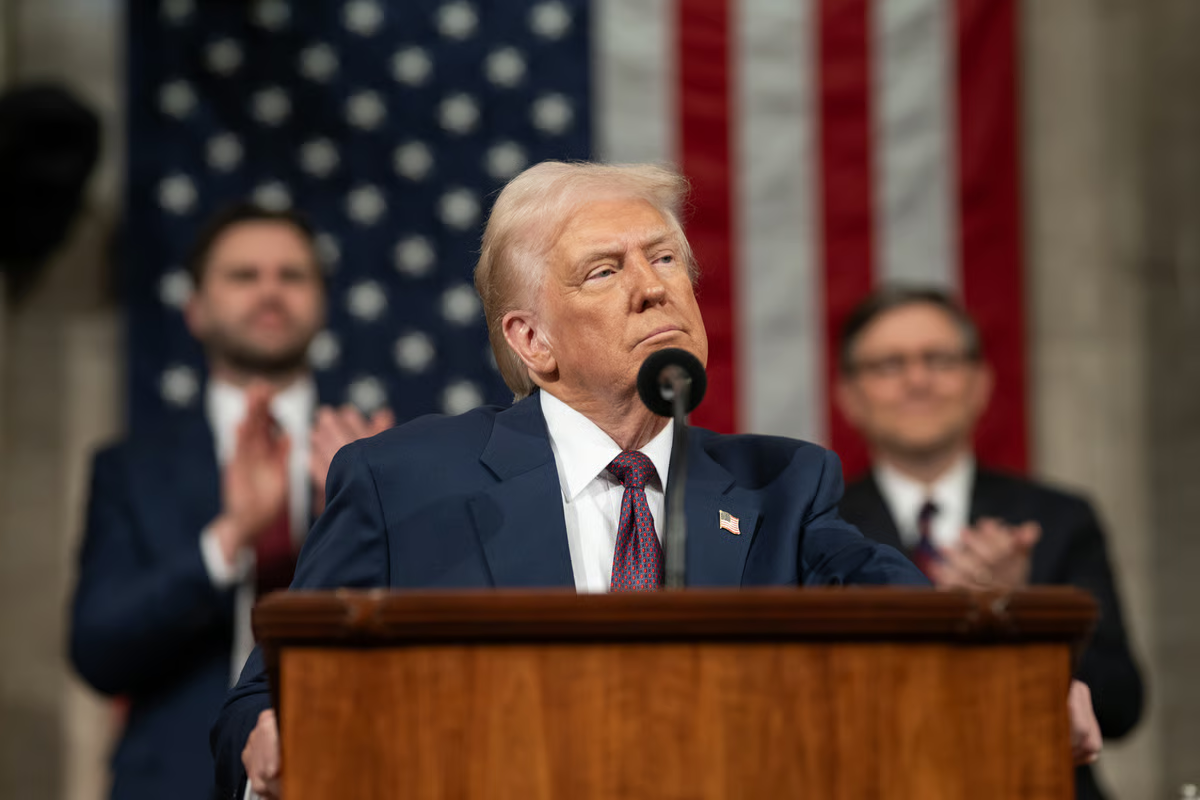
President Trump has issued a stark warning regarding the potential economic fallout if the Supreme Court rules against his administration’s tariffs, which he claims could lead the United States to face a depression reminiscent of the Great Depression in 1929. His assertion comes as the S&P 500, a key indicator of the U.S. stock market, has significantly risen—showing a 17% increase in 2025, despite the uncertainty wrought by these tariffs.
Currently, tariffs imposed by the Trump administration have raised the average tax rate on U.S. imports to 16.8%, a dramatic jump from 2.5% the previous year. Such elevated tariff rates haven’t been witnessed in nearly a century, and they have escalated at an unprecedented pace. The administration has relied on the International Emergency Economic Powers Act (IEEPA), a law from 1977 that lacks explicit provisions for imposing tariffs. Recent court rulings have challenged the legality of these tariffs; earlier this year, the Court of International Trade deemed them illegal, a decision upheld by the U.S. Court of Appeals.
The Supreme Court recently heard arguments on the matter, and early reports indicate that many justices are skeptical of the administration’s justification for imposing these duties. A ruling is expected in the coming weeks, with significant implications for the U.S. economy.
Trump has framed a Supreme Court decision against his tariffs as a potential “economic disaster.” On social media, he cautioned that it could herald a return to the economic conditions of 1929. This raises concerns among investors about the potential for a market crash if such a ruling occurs.
Despite the rhetoric from the Trump administration, economic indicators suggest a disconnect between their views and tangible economic realities. The U.S. Constitution grants the power to impose and collect taxes to Congress, and there is contention regarding whether tariffs should be classified as taxes. Treasury Secretary Scott Bessent contended that tariffs don’t qualify as taxes, a perspective contradicted by many economists and dictionary definitions.
Bessent has also suggested that tariffs are beneficial for labor, claiming they will revitalize U.S. manufacturing jobs and bolster national security. However, recent data tells a different story, with hiring rates reaching their lowest levels in over a decade, an unemployment rate of 4.4%—the highest in four years—and a manufacturing sector that has contracted for nine straight months. Additionally, consumer sentiment has plummeted, averaging 57.6 in 2025, the lowest in recorded history.
Should the Supreme Court rule against the tariffs, there could be reversals in these negative economic trends—potentially leading to improved hiring, lower unemployment, and a rebound in consumer sentiment, all critical drivers of GDP. However, the stock market could still see a decline if the decision mandates repayment of the revenues collected from the IEEPA tariffs, which amounted to about $90 billion in the last fiscal year.
This scenario poses a significant concern for the stock market as the government may need to issue more Treasury bonds to cover those repayments, raising federal debt levels. Investors wary of increasing debt could demand higher interest rates as compensation for risk, which would likely impact stock market performance negatively.
In summary, while the stock market may face volatility depending on the Supreme Court’s ruling regarding the tariffs, investors are encouraged to maintain focus on long-term returns. Historically, the S&P 500 has yielded an average annual return of 10.4% over the past three decades, suggesting that even amid short-term fluctuations, long-term growth remains a possibility.