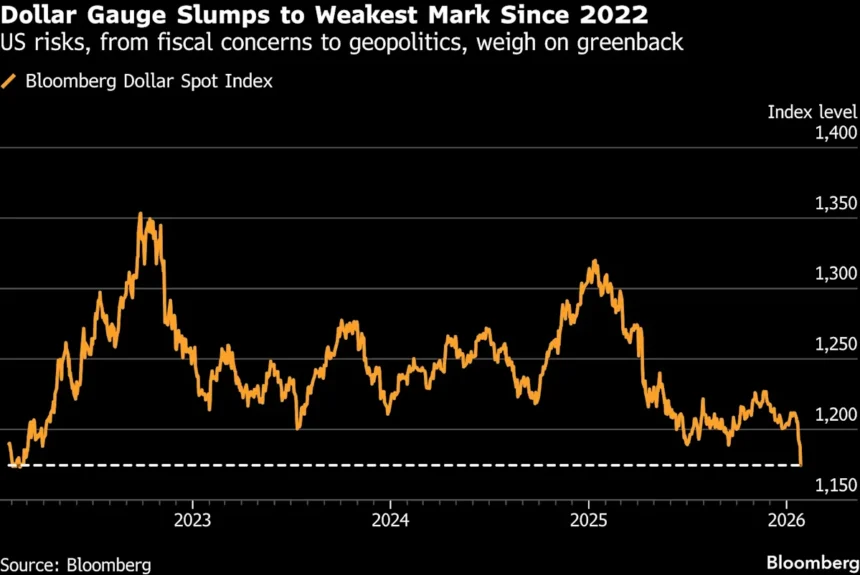
President Donald Trump’s recent comments regarding the dollar have sparked speculation about a potential long-term decline for the U.S. currency. Following his statement on Tuesday indicating that he did not perceive an excessive weakening of the dollar, the currency posted its steepest one-day drop since the rollout of tariffs last year. Bloomberg’s dollar gauge plummeted as much as 1.2% in response to the remarks, diminishing the appeal of the dollar and U.S. Treasuries, which has led to what is now being referred to as the “debasement trade.”
Stephen Jen, founder of Eurizon SLJ Capital, views the administration’s rationale surrounding the dollar as a precursor to prolonged declines, as officials appear to be targeting an exchange rate that benefits American exporters. In a note preceding Trump’s comments, Jen suggested that this trend could be the start of a new downward trajectory for the dollar, catching many analysts off guard. He remarked on the challenges this poses for a generation of currency analysts used to a strong dollar and robust U.S. economy, who may struggle to grasp a scenario featuring both a weakening dollar and a strong economy.
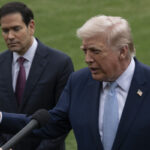
In Iowa, Trump asserted that the dollar’s recent decline is favorable for U.S. businesses. His outlook aligns with previous statements from U.S. officials, but many viewed his comments as validation for the dollar’s significant downturn in recent days. During New York trading, Bloomberg’s dollar index fell to its lowest level in nearly four years before slightly recovering in Asian markets. The dollar’s decrease contributed to the euro and pound reaching their highest values since 2021, while the Swiss franc climbed to its peak since 2015. In Asia, currencies such as the South Korean won and Malaysian ringgit also gained strength against the dollar. Gold experienced a surge, hitting a record price above $5,250 an ounce.
Anthony Doyle, chief investment strategist at Pinnacle Investment Management in Sydney, noted that when a key figure like Trump, who could potentially support the currency, expresses indifference to its decline, the perceived safety net for the dollar diminishes. This observation raises questions about whether the U.S. is asking investors to accept a lower standard of stability, thereby necessitating a higher risk premium.
Trump’s apparent endorsement of a weaker dollar may deter foreign holders of U.S. assets, coinciding with recent tariff threats against key allies and critiques of the Federal Reserve’s independence. Observers interpret his disinterest in the dollar’s decline as an encouragement to divest from the currency and accelerate movements away from assets such as Treasuries.
Market indicators also suggest increasing anxiety over a possible long-term depreciation of the dollar. A gauge tracking risk reversals for the dollar against major currencies recently fell to its lowest since June, signaling heightened demand for protective options against a weaker dollar. Furthermore, data from the Organisation for Economic Co-operation and Development indicates that the dollar is overvalued relative to nearly all of its Group-of-10 peers, with the exception of the Swiss franc, while the yen and euro appear particularly undervalued, suggesting foreign exporters may gain advantages.
Not all analysts interpret Trump’s remarks as heralding a long-term dollar selloff. Rodrigo Catril, a currency strategist at National Australia Bank Ltd., argues that the administration’s comments indicate a desire for currencies like the Chinese yuan and Japanese yen to appreciate rather than a push for a generational shift in the dollar’s strength, though the ambiguity surrounding the dollar’s position introduces additional uncertainty.
Robert Kaplan, vice chairman at Goldman Sachs, highlighted potential risks associated with a prolonged dollar weakness. While a weaker dollar may enhance exports, he emphasized the importance of currency stability, especially given the U.S.’s significant debt nearing $40 trillion. Kaplan underscored that stability in the dollar is essential for the effective sale of long-term Treasury bonds, suggesting that U.S. interests might incline towards maintaining a stable currency over prioritizing exports.