









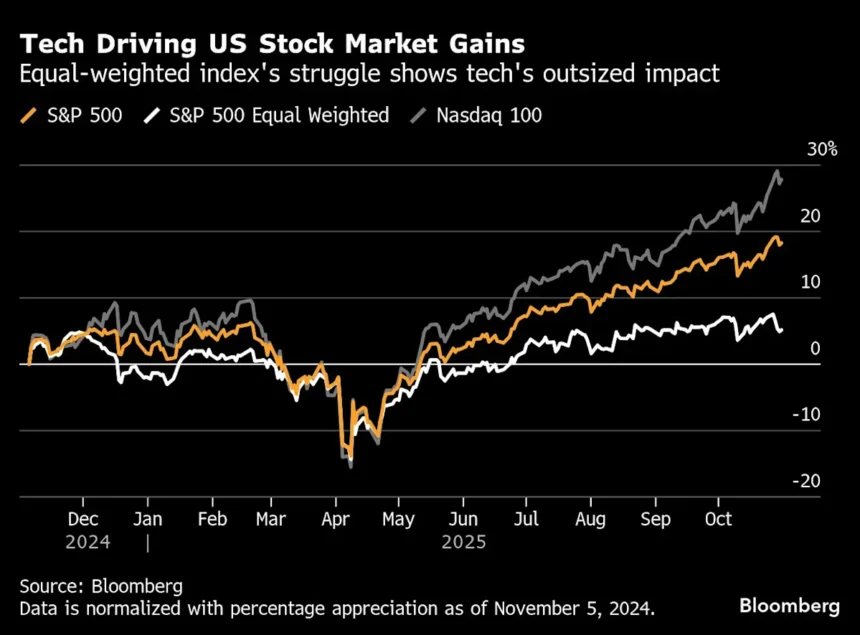
Donald Trump’s re-election has resulted in a notable surge in the stock market, though the dynamics behind this growth have deviated from earlier predictions. The S&P 500 Index has climbed an impressive 18% since Trump’s victory on November 5, culminating in a six-month streak of gains and reaching an all-time high as October ended. Investors initially anticipated this performance would stem from an anticipated economic boom, tied to Trump’s plans for tax cuts and regulatory rollbacks.
However, while these cuts have largely taken effect, it is the unpredictable nature of Trump’s trade policies that has greatly influenced market behavior. Ongoing tariff threats and subsequent policy reversals have heightened uncertainty to levels not seen since 1900, resulting in spikes in market volatility. Dean Curnutt, CEO of Macro Risk Advisors LLC, remarked on the unprecedented volatility, describing it as one of the most significant instances witnessed in recent history.
Despite the turbulent backdrop, enthusiasm around artificial intelligence (AI) has also played a crucial role in energizing the stock market. Big Tech companies have significantly contributed to the market boom, while traditional industrial and consumer goods sectors have struggled. A version of the S&P 500 that removes the influence of larger market-cap stocks has only increased by 5.2% this year, highlighting the notable disparities in performance within the index. The median stock has seen minimal growth of just 1.2%.
AI has led to significant gains for tech giants; for instance, Nvidia Corp. has emerged as the first company to achieve a market capitalization of $5 trillion, while Apple Inc. and Alphabet Inc. have achieved valuations surpassing $4 trillion. Collectively, the seven largest tech companies have accounted for more than half of the market’s growth, as investors express optimism about the future advancements in AI technology.
As the AI craze flourished, so did the volatility driven by ongoing trade policy discussions. For instance, Trump’s intervention with Intel Corp. led to a revival of its stock price, as the company agreed to provide the U.S. government a 10% stake in exchange for a grant. Similar actions involving companies like U.S. Steel and various mining firms have created significant impacts on their respective stocks.
Market volatility intensified with Trump’s public discussions regarding Federal Reserve policies, leading to further investor anxiety. Curnutt expressed concerns that ongoing fluctuations might gradually weaken market resilience, likening it to an edifice that suffers from constant shaking. Despite these fluctuations, a recent 18% gain since Trump’s election is still considered commendable, albeit when compared to the previous year’s extraordinary 36% growth.
On a global scale, U.S. stocks have lagged behind other markets, ranking 54th over the past year, failing to keep pace with gains in Canada, Japan, and Germany. Compared to the first year of other presidential terms over the last eight decades, Trump’s performance ranks eighth, trailing behind others like Joe Biden and Barack Obama.
Consumer stocks, in particular, have faced challenges, exemplified by the recent decline of Chipotle Mexican Grill Inc.’s shares, amidst concerns over a slowdown in customer traffic. The consumer staples sector has also seen a downturn as tariff impacts become evident. Likewise, the materials sector has struggled, facing an 8% decline due to rising input costs that have further complicated trade dynamics.
Nonetheless, the buoyancy from the AI sector has made it increasingly difficult for investors to refrain from capitalizing on U.S. stocks, noted Curnutt. The combination of market size, liquidity, and growth potential continues to draw a wide range of investors, despite the looming threats of volatility and tariffs.
There are indications that Trump’s trade-induced uncertainties may be starting to diminish, particularly after his recent travels in Asia that produced favorable outcomes. Furthermore, concerns regarding AI competition with China have eased since February, with corporate earnings consistently bolstering stock valuations.
Moving forward, market analysts like Michael Dickson from Horizon Investment LLC express increased confidence compared to last year. As clarity surrounding AI infrastructure spending emerges, investors appear more inclined to embrace the potential benefits rather than retreat from the market due to other risks.
While the pursuit of AI-related stocks continues to attract interest, some caution remains given potential warnings of a bubble. The impact of tariffs might show consequences for American consumers, particularly for low-income borrowers, and inflationary pressures could hamper aggressive interest rate cuts by the Federal Reserve.
Experts predict a landscape where investors must navigate dual risks: the potential for a market correction due to high stock valuations and the possibility of missing out on another significant rally from AI stocks, with hopes remaining that broader economic acceleration could be on the horizon.