Since the onset of hostilities with Iran initiated by President Donald Trump in late February, the U.S. economy has faced a barrage of shocks. Gas prices have surged by nearly 40%, surpassing $4 per gallon, while dated Brent crude oil has risen sharply, recently hitting $141 per barrel—marking the highest level since the 2008 financial crisis. Major financial institutions, including Vanguard and the Federal Reserve Bank of Atlanta, have raised their inflation expectations and downgraded growth forecasts, with the Fed’s GDP tracker plummeting from 3% in early March to just 1.6% as of last Thursday.
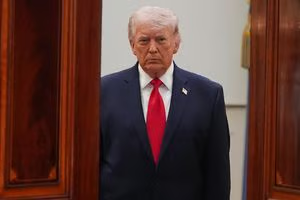
Despite these significant economic shifts, the public discourse has largely focused on the volatility of the stock market—often reacting dramatically to presidential statements. For instance, on March 23rd, at around 7 a.m., Trump announced on Truth Social that productive discussions with Iran were underway, hinting at a potential resolution of hostilities. This claim instigated a swift reaction in the markets, with the S&P 500 rising by 2.6% and adding roughly $2 trillion in market value. Simultaneously, oil prices plummeted, and the Dow looked poised for a significant opening gain.
However, by 8 a.m., Iran swiftly refuted Trump’s claims, characterizing them as “psychological warfare” and denying any contact with the U.S. president. The immediate consequence was a dramatic reversal of fortunes, with approximately $1 trillion of earlier gains being wiped out in a matter of hours. This swift market swing of $3 trillion within just a few hours illustrates how deeply intertwined the stock market has become with geopolitical actions and statements.
The acceleration of algorithmic trading and sentiment analysis further magnified these market dynamics, with many trades influenced heavily by real-time perceptions of news. Furthermore, Iranian officials, including parliamentary speaker Mohammad-Bagher Ghalibaf, have taken to social media to lampoon Trump’s assertions. Ghalibaf suggested that American investors should see Trump’s reported negotiations as a signal to engage in profit-taking, implying that the opposite of the U.S. narrative could yield profitable opportunities.
This ongoing information warfare has seen Ghalibaf leverage Trump’s credibility issues, as prominent news outlets quickly undermined the president’s claims by revealing that the discussions he mentioned were far from substantive. Reports indicated that any “conversations” were merely initial exchanges facilitated by Middle Eastern intermediaries, rather than direct U.S.-Iran negotiations. Furthermore, intelligence assessments indicated that Iran was not prepared to engage in any meaningful discussions or ceasefire agreements.
Experts suggest that the rapid and often erratic market reactions may represent a new frontier where the stock market essentially becomes a battleground for broader geopolitical conflicts. Igor Pejic, an expert on financial dynamics, notes that this phenomenon is not entirely unprecedented but manifests in an unusually extreme way given today’s real-time information flux. He warns that markets may increasingly operate as a “Trump trade” rather than responding to fundamental economic realities, thus heightening volatility and leading to confusion among longer-term investors.
This scenario threatens to create an environment where official statements might not only be met with skepticism but could fundamentally alter how investors react to genuine news, skewing market perceptions and delaying meaningful price adjustments. The potential for adversarial parties—such as Iran—to exploit this growing distrust only adds another layer of complexity to the economic landscape during this unprecedented conflict.