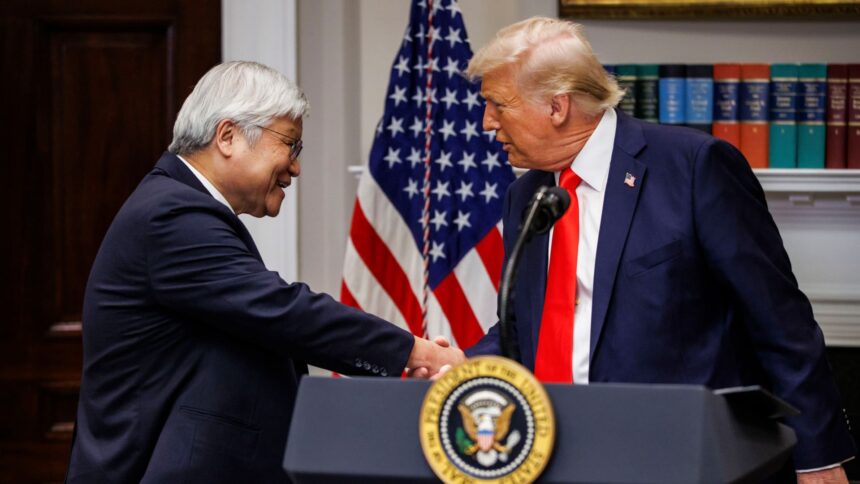
U.S. President Donald Trump and C.C. Wei, CEO of Taiwan Semiconductor Manufacturing Co. (TSMC), recently announced a significant commitment by the company to enhance its manufacturing capabilities in the United States. At a White House event, it was revealed that TSMC would invest an additional $100 billion into its operations in the U.S., building on an already substantial commitment of $165 billion as part of a broader strategy to address domestic chip production.
The announcement comes on the heels of TSMC’s impressive earnings report, which has bolstered confidence in the company’s future. TSMC, the largest contract chipmaker globally, is particularly focused on expanding its capacity to cater to the rapidly growing demand for artificial intelligence chips. In a conversation with CNBC, TSMC Chief Financial Officer Wendell Huang emphasized the company’s intention to significantly ramp up investments in Arizona, stating, “We have strong conviction on the AI mega trend, and that is the reason we are stepping up the capital expenditures to expand in Taiwan and in the U.S.”
Furthermore, C.C. Wei revealed plans to construct a “gigafab cluster” in Arizona, following the recent acquisition of additional land in the state. Although the specific financial details of these expansions were not disclosed, TSMC anticipates capital expenditures will rise by over 30% in the upcoming year compared to the previous one.
A critical backdrop to TSMC’s U.S. expansion is a newly signed trade agreement between the U.S. and Taiwan. This deal will reduce U.S. tariffs on Taiwanese goods from 20% to 15% and includes commitments from Taiwanese companies to invest $250 billion directly into U.S. sectors like semiconductors and AI, along with an equal amount in credit guarantees to bolster supply chains. U.S. Commerce Secretary Howard Lutnick highlighted that the objective of the trade agreement is to relocate 40% of Taiwan’s semiconductor supply chain to the U.S., further supporting domestic manufacturing initiatives.
Prior to TSMC’s earnings report and the establishment of the trade deal, there were reports that the company had been planning a substantial expansion in Arizona as part of ongoing trade negotiations. However, Huang clarified that TSMC’s investment decisions are motivated by customer demand rather than direct correlations to trade talks, asserting, “The [U.S.-Taiwan] trade deal is between two governments, and we are not part of the discussions.”
Despite earlier delays and concerns regarding its U.S. facilities, TSMC reports that its first fabrication plant is now operational and produces chips with yields and technology standards comparable to its top facilities in Taiwan. Huang expressed pride in the company’s ability to replicate its manufacturing excellence in the U.S., framing it as a significant milestone for both TSMC and its clients.
Nonetheless, Huang also mentioned that TSMC would continue to conduct research and develop its most advanced technologies in Taiwan, due to better collaboration between research and manufacturing there, as well as higher profit margins stemming from lower labor costs.
Looking ahead, TSMC is accelerating its timelines for the construction of its second Arizona plant, aiming for operational status by the second half of 2027, and plans to expedite the development of a third facility this year. The company is also seeking permits for a fourth plant to accommodate future growth.
Originally, TSMC’s plans for its initial 1,100 acres in Arizona included multiple wafer fabrication plants, advanced packaging facilities, and a research and development center. However, as expansion needs grew, TSMC purchased an additional 900 acres to facilitate its scaling ambitions. Some of the facilities initially planned for the first piece of land will now be relocated to the newly acquired lot, ensuring operational flexibility for future developments.
In financial markets, TSMC shares experienced a notable uptick, trading up more than 3% in Taipei, reflecting positive investor sentiment following the unveiling of its expansion plans and the favorable trade agreement.