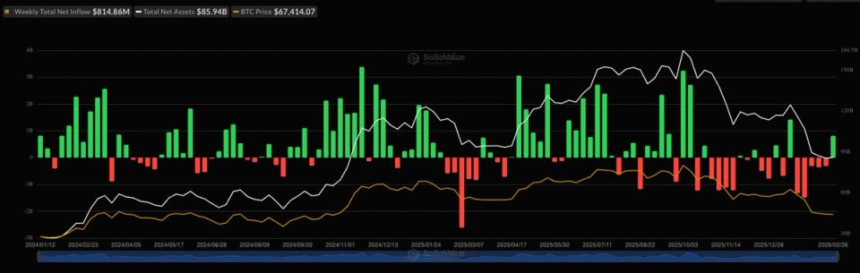
In a significant turnaround for the U.S. bitcoin exchange-traded funds (ETFs), recent data indicates that these funds are poised to end a five-week streak of net outflows, signaling a resurgence in investor interest. Over a concentrated period of just three days, the ETFs recorded impressive net inflows totaling $1.1 billion, with the latest figures showing they are approximately $815 million ahead after accounting for Monday’s net outflow. This marks the strongest performance for bitcoin ETFs since mid-January, during which $1.4 billion in inflows were noted.
A notable contributor to this rebound is BlackRock’s iShares Bitcoin Trust (IBIT), which attracted over half of the recent inflow, amounting to around $652 million. Additionally, Grayscale’s Bitcoin Trust (GBTC), which is known for having the highest fees among such funds, experienced its largest single-day inflow since transitioning from a trust structure to an ETF.
The renewed interest in U.S. bitcoin ETFs indicates a rebound in domestic demand, further substantiated by positive movements in the Coinbase Premium Index. This index tracks the price discrepancy between bitcoin traded on Coinbase, a platform commonly used by institutional investors in the U.S., and the broader global market. After languishing in negative territory for 40 days, the index has now turned positive, suggesting an uptick in institutional activity and sentiment regarding bitcoin.
Data from Checkonchain reveals that total bitcoin holdings across U.S. spot ETFs have surged to 1.29 million BTC, bringing assets under management (AUM) to less than 10% shy of their peak in October, despite the current spot price of bitcoin being 45% below its record high from that timeframe. Throughout this week, the leading cryptocurrency has maintained a steady consolidation around the mid $60,000 range.
In contrast, open interest on the Chicago Mercantile Exchange (CME) has shown a continuous decline, currently standing at 107,780 BTC, as reported by Glassnode. The CME’s framework allows institutional investors to adopt a basis trade strategy—taking a long position in spot bitcoin and a short position in futures simultaneously. The decrease in futures market activity is perceived as a strong indication that the ongoing ETF inflows are largely composed of outright long positions, reflecting a growing confidence among institutional players in the bitcoin market.