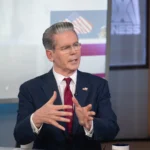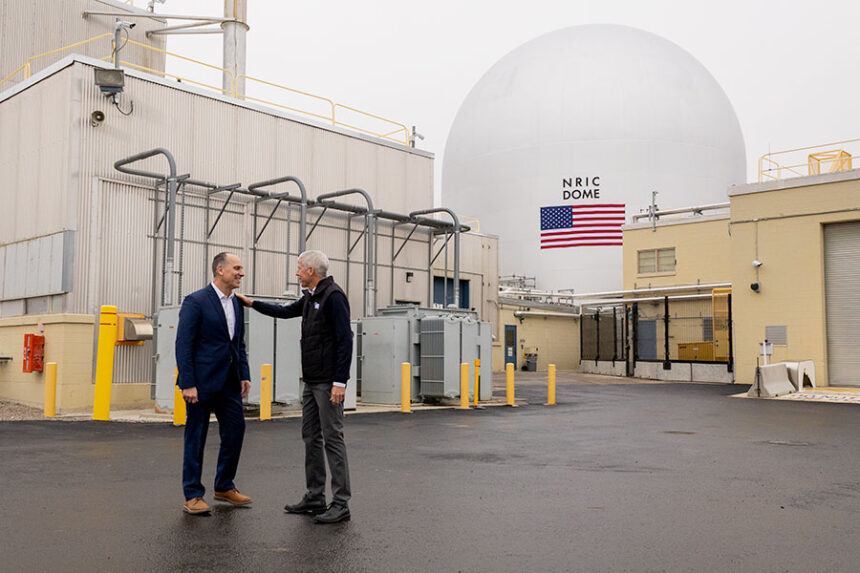
On Monday, U.S. Department of Energy Secretary Chris Wright visited the Idaho National Laboratory (INL) as part of a comprehensive tour across all 17 national laboratories, underscoring a renewed focus on nuclear energy in the United States. This particular visit holds special significance, as Southeast Idaho has long been a hub for nuclear innovation, with many reactor designs tracing their origins back to the INL.
Wright emphasized Idaho’s pivotal role in nuclear development, pointing out that the state represents the forefront of what he termed a “nuclear renaissance.” He applauded the momentum created by the previous administration, stating, “This is ground zero for the nuclear renaissance that the Trump administration is passionate about making happen.” He highlighted that while discussions around revitalizing the nuclear sector have been ongoing for decades, tangible advancements are finally coming to fruition.
A significant development at the INL is the recent groundbreaking for the Aurora plant, a collaboration with Oklo, which marks the first new nuclear reactor project in decades at the site. This endeavor was made possible by an executive order signed by former President Donald Trump, aimed at fast-tracking the construction of new reactors in the private market.
Mike Goff, the principal deputy assistant secretary for the Department of Energy’s Office of Nuclear Energy, revealed in a previous statement that this executive order is part of a broader initiative to revitalize the nuclear industry in America. Since the initiation of this push, four executive orders have been issued to streamline processes and foster nuclear development.
Wright elaborated on the administration’s goals, mentioning a commitment to have multiple reactors operational by July 4 of the upcoming year, a target that reflects the urgency of this initiative. Historically, since the establishment of the Nuclear Regulatory Commission over 50 years ago, the U.S. has only managed to bring two reactors online, highlighting the bureaucratic challenges that have hindered progress.
To overcome these hurdles, Wright indicated that the Department of Energy plans to offer targeted grants to incentivize private companies to participate in the development of new reactors and associated fuels. Notably, funding for these grants will come from reallocating subsidies traditionally given to wind and solar energy projects. Additionally, tax incentives for nuclear and geothermal technology development will be available for eight years.
A key destination during Wright’s tour was the Demonstrations of Microreactor Experiments (DOME), which served as a containment dome for the Experimental Breeder Reactor-II and is set to be retrofitted for microreactor testing. John Wagner, the INL Director, mentioned that Radiant Nuclear will be the inaugural company to test its microreactor within the DOME. The aim is for this reactor to go critical safely in a controlled setting by next July, aligning with the administration’s timeline.
Wright asserted that the Trump administration is not solely focused on traditional energy sources. He noted efforts to enhance the nation’s power capacity beyond fossil fuels. The INL is at the forefront of developing high-assay low-enriched uranium (HALEU), which will play a critical role in the evolution of nuclear fuel technology.
“Our work is going to bridge the gap for these next generation fuels,” Wright claimed, emphasizing private industry’s eventual role in supplying the reactors needed to meet future energy demands.