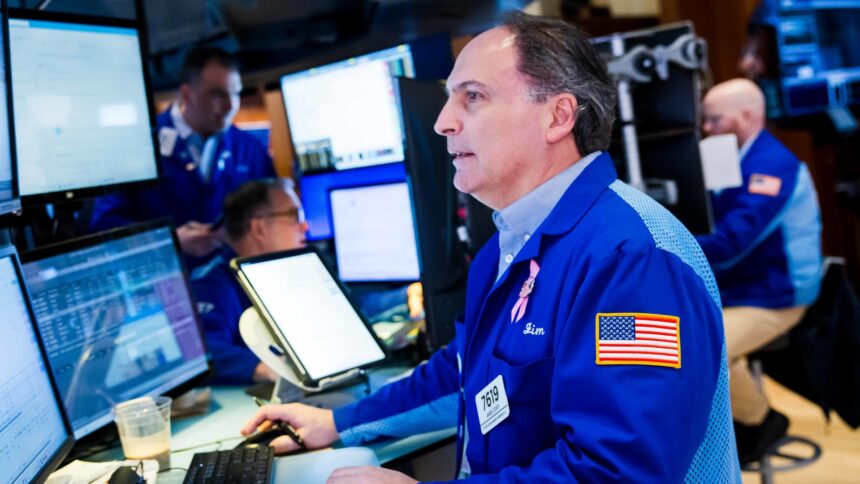
U.S. equities experienced another day of significant decline on Thursday, reflecting a growing risk-off sentiment among investors. The Dow Jones Industrial Average fell by 647 points, or 1.3%, while the S&P 500 and the Nasdaq Composite dropped by 1.5% and 1.8%, respectively. This downward trend puts the Nasdaq on track for its most substantial three-day loss since April 2025.
Alphabet, part of the so-called “Magnificent Seven” companies, recently reported its earnings and raised eyebrows with a projection of a dramatic increase in artificial intelligence-related spending. The company is forecasting capital expenditures reaching up to $185 billion in 2026, prompting a 5% decline in its shares as investors reacted cautiously to the news. In contrast, Broadcom experienced a boost, with shares rising nearly 2% in response to Alphabet’s spending plans, suggesting a potential silver lining for the AI sector despite the turbulent market.
Meanwhile, Qualcomm faced difficulties, witnessing a 7% drop in its stock price after delivering a weaker-than-anticipated forecast, affected notably by a global memory shortage.
The cryptocurrency market continued to experience turbulence, with Bitcoin falling below the crucial $67,000 mark, having previously dipped below $70,000. This decline marks a significant shift in sentiment for digital currencies after a period of stability. In the precious metals market, silver prices resumed their downward trajectory, erasing the gains from a two-day rebound, with a notable 16% drop following a near 30% plummet the previous Friday.
The overarching mood of the market was further dampened by rising concerns related to labor market weakness. Outplacement firm Challenger, Gray & Christmas reported that U.S. employers announced 108,435 layoffs in January, the highest figure for that month since the global financial crisis. Additionally, initial jobless claims for the week ending Jan. 31 exceeded expectations, and the Bureau of Labor Statistics reported that job openings in December fell to the lowest level since September 2020.
Investors are still reeling from a turbulent trading session that saw significant selling in software and chip stocks, which contributed to the S&P 500’s consecutive days of losses. As fears mount regarding potential AI disruption within the industry, investors are increasingly shifting away from tech stocks in favor of more attractively valued sectors of the market.
Mark Haefele, chief investment officer at UBS Global Wealth Management, emphasized the changing landscape, noting that after three years of robust AI rallies fueled by capital expenditure expansions, investors are now prioritizing AI spending that is coupled with strong revenue growth. As AI technologies continue to transform various industries, Haefele suggested that the current sell-off may not be a singular event, indicating a challenging road ahead for certain sectors within the market.