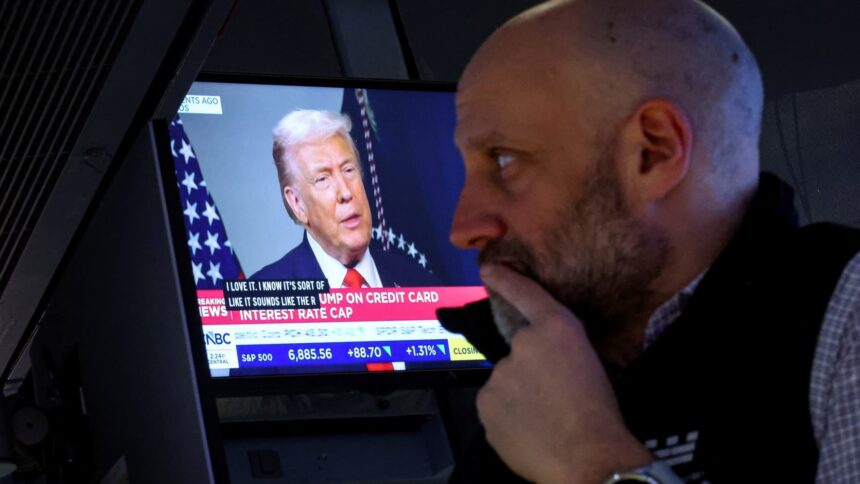
A significant diplomatic rift between the United States and Europe regarding the status of Greenland created noticeable turbulence in financial markets this past week, although the S&P 500 ultimately managed to end the holiday-shortened trading period close to its starting point.
Over the weekend, President Donald Trump intensified his campaign to annex Greenland, a territory controlled by Denmark, by issuing threats to impose tariffs on imports from eight European countries that opposed the idea. The proposed tariffs, aimed at longstanding allies—Denmark, Norway, Sweden, France, Germany, the United Kingdom, the Netherlands, and Finland—were set to begin on February 1 at a rate of 10%.
Traders, returning from the Martin Luther King Jr. holiday, were greeted with a market in disarray. On Tuesday, both the S&P 500 and the Nasdaq Composite fell by approximately 2%, while the Dow Jones Industrial Average plummeted by 870 points, reflecting investors’ concerns about escalating trade tensions.
However, a dramatic turnaround occurred on Wednesday when President Trump announced that he and NATO Secretary General Mark Rutte had established a “framework” for future negotiations concerning Greenland, subsequently retracting the planned tariffs. This news triggered a surge in U.S. stock prices, with the rally continuing into Thursday, resulting in the S&P 500 ending the week down by only a small fraction.
Market analysts were puzzled by the initial muted response to earlier threats. Tom Garretson, senior portfolio strategist at RBC Wealth Management, questioned why the market didn’t react sooner, speculating that traders were reassured by an awareness of the administration’s tendencies to avoid actions that could have adverse market effects. Jed Ellerbroek from Argent Capital Management remarked that if investors really believed in the seriousness of the president’s threats, the market would have faced much larger losses than the 2% drop seen on Tuesday.
Despite lingering concerns about geopolitical unrest and trade tensions, some market experts note a general optimism about the underlying fundamentals of the economy. Scott Ellis, managing director of corporate credit at Penn Mutual Asset Management, acknowledged the potential for volatility but remained optimistic about stock performance in the long run, emphasizing the importance of diversification.
Amidst the turmoil, Eric Parnell, chief market strategist at Great Valley Advisor Group, suggested that the current volatility could create opportunities for investors. He noted that while the prospect of annexing Greenland was shocking, the rapid reversal from the White House helped to stabilize markets. He pointed out that international and emerging markets had a strong year previously and maintained a positive outlook on these sectors for the future.
As global political events continue to unfold, the financial markets remain vigilant, balancing optimism for strong macroeconomic indicators with the ever-present threat of sudden geopolitical shifts.