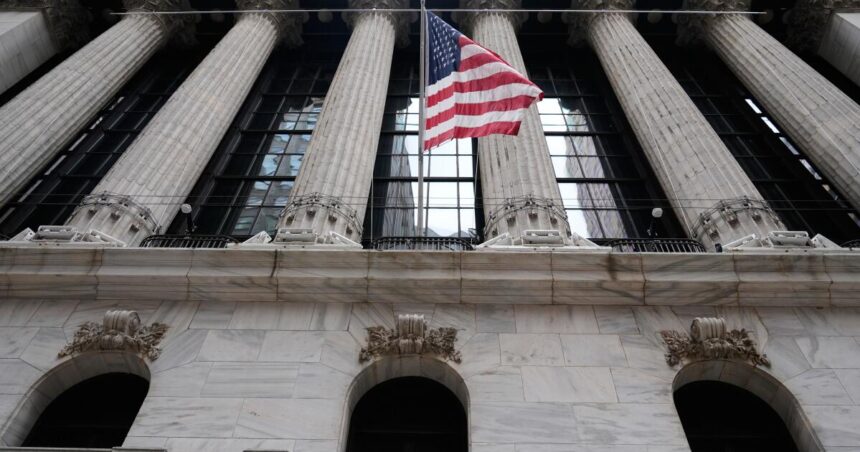
U.S. futures experienced a decline early Friday, following the release of unexpectedly robust job growth data from the federal government. While equity markets remained closed for Good Friday, futures trading saw slight movement, with S&P 500 futures dipping 0.3%, Dow Jones Industrial Average futures falling by 0.2%, and Nasdaq futures decreasing by 0.4%.
Recent statistics indicated that American employers added an impressive 178,000 new jobs last month, rebounding from a significant February loss of 133,000 jobs. The unemployment rate also saw a decrease, falling to 4.3% from the previous rate of 4.4%.
In energy markets, trading was suspended following a surge in prices the day before, attributed to concerns over the protraction of the conflict in Iran. On Thursday, U.S. benchmark crude saw an increase of 11.4%, reaching $111.54 per barrel, while the price of Brent crude, the international benchmark, rose by 7.8% to $109.03 per barrel.
President Trump, in remarks made late Wednesday, reaffirmed the U.S. commitment to ongoing military actions in Iran, without providing a clear timeline for resolution of the conflict. A report from BMI, a division of Fitch Solutions, noted that an extended conflict could pose threats to physical infrastructure, and risk prolonged disruptions in the strategically critical Strait of Hormuz, which could have longer-term implications for oil prices throughout the year. Although the U.S. relies only on a small portion of oil imports from the Persian Gulf, global commodity prices are influenced by international tensions.
In contrast, the situation is markedly different for many nations in Asia, including Japan—heavily reliant on oil imports via the Strait of Hormuz. Analysts suggest that countries like Japan may be counting on negotiations with Iran to facilitate safe transportation of fuel through this vital shipping route.
Trading was halted in major European markets, including France, Germany, and Britain, in observance of the Good Friday holiday. Meanwhile, in Asian markets, Japan’s benchmark Nikkei 225 index closed 1.3% higher at 53,123.49, while South Korea’s Kospi index surged by 2.7% to finish at 5,377.30. However, the Shanghai Composite index saw a decrease of 1.0%, closing at 3,880.10. Numerous markets across the region, including those in Hong Kong, Singapore, Australia, New Zealand, the Philippines, Indonesia, and India, also observed the holiday and were closed for trading.