U.S. futures experienced a decline, while Asian markets largely posted gains on Monday after the Supreme Court ruled against the majority of former President Donald Trump’s extensive tariffs. In the wake of this judicial decision, the cryptocurrency Bitcoin saw a sharp drop of up to 5%, falling below $65,000. This decline stemmed from investors retreating from speculative assets amid growing concerns regarding potential government regulation of the cryptocurrency market. Bitcoin, often referred to as “digital gold,” has experienced a significant downturn, losing nearly half of its value since its peak of $126,210.50 on October 6.
With markets in Japan and mainland China closed for holidays, Hong Kong’s Hang Seng index led the regional gains, jumping 2.2% to reach 26,980.22. In contrast, South Korea’s Kospi index surrendered early advances, slipping 0.1% to settle at 5,809.53. Australia’s S&P/ASX 200 fell by 0.6%, finishing at 9,024.40. However, Taiwan’s Taiex ticked up by 0.5%, and India’s Sensex was up by 0.4%, while the SET index in Bangkok increased 1.1%.
The mixed market reactions underscore the “winners-and-losers effect” triggered by the shifts in tariff policy, which have benefited countries that were previously at a disadvantage, according to Benjamin Picton of Rabobank. He noted that U.S. tariff policy would continue to create uncertainty in the markets as traders assess its implications.
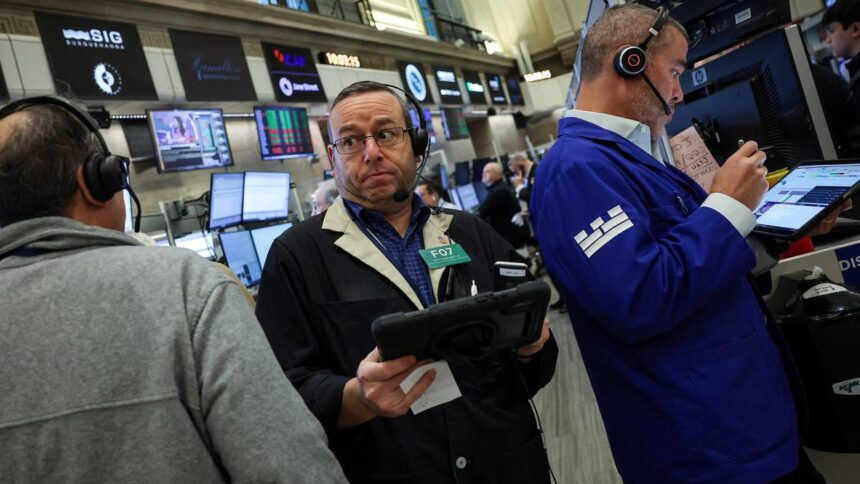
Futures for the S&P 500 fell by 0.8%, while the Dow Jones Industrial Average futures dropped 0.7%, and the Nasdaq composite index futures declined 1%. On Wall Street, the previous Friday had seen a calm response following the Supreme Court’s ruling, which had initially sparked panic when Trump’s tariffs were introduced last year. The S&P 500 closed up 0.7% at 6,909.51 while flipping between minor gains and losses earlier in the session. The Dow Jones Industrial Average experienced a 0.5% increase, closing at 49,625.97, and the Nasdaq composite rose 0.9% to 22,886.07.
Despite the court’s decision, Trump announced plans to explore alternative avenues for imposing import taxes, having expressed dissatisfaction with the ruling. He indicated intentions to sign an executive order for a 10% global tariff, which he later increased to 15%, and is considering other tariffs requiring investigations by the Commerce Department.
On Wall Street, Akamai Technologies suffered one of the largest declines, plummeting 14.1%. The cybersecurity and cloud computing firm reported better-than-expected results for the previous year; however, its profit forecast for the upcoming year disappointed analysts. Akamai’s plans to allocate a higher percentage of its revenue on equipment and investments may signal the impact of AI-related shortages on businesses across the economy.
Economic reports revealing slowed growth and rising inflation received a muted response from traders. These insights emphasize the Federal Reserve’s difficult position regarding interest rates but did not drastically alter expectations for future monetary policy. Market participants continue to anticipate at least two rate cuts this year, despite the risks such cuts pose to inflation.
In commodity markets on Monday, U.S. benchmark crude oil fell by 77 cents to $65.71 per barrel. The international standard, Brent crude, decreased by 74 cents to $70.56 per barrel. The U.S. dollar weakened against the Japanese yen, dropping from 154.94 to 154.40 yen. Conversely, the euro gained ground, rising to $1.1820 from $1.1797. In the precious metals market, gold prices climbed by 1.9%, while silver saw an increase of 5.4%.