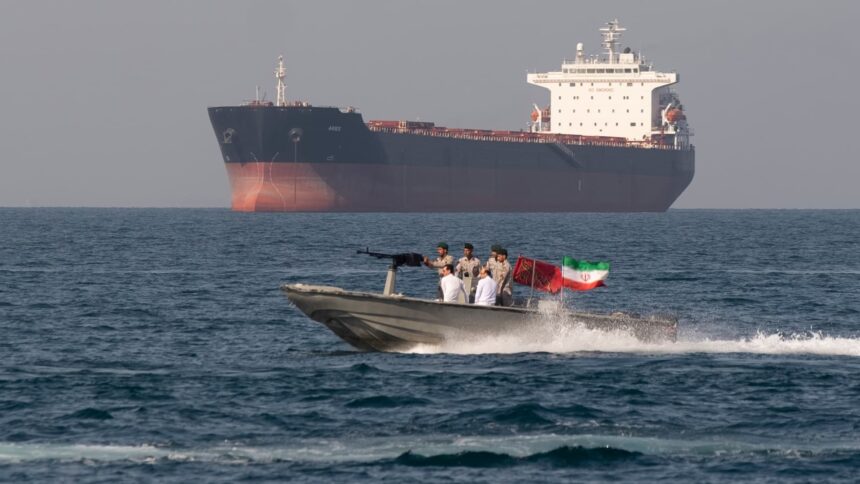
The recent joint military action by the United States and Israel against Iran, a key member of OPEC, has raised serious concerns about potential disruptions in global oil supplies. As one of the largest oil producers in OPEC, Iran produces just over 3 million barrels of oil daily and holds significant influence over the vital Strait of Hormuz, the crucial maritime route through which a significant portion of the world’s oil trade passes.
Following the attacks, experts suggest that crude oil prices could spike significantly when trading resumes. Bob McNally, a former energy advisor to President George W. Bush and now the president of Rapidan Energy, indicated that prices might increase by $5 to $7 per barrel. On the previous Friday, Brent crude closed at $72.48 per barrel, reflecting a rise of 2.45%, while U.S. West Texas Intermediate saw a similar uptick, finishing at $67.02 per barrel.
The threat of Iranian retaliation looms large, particularly given Tehran’s established military capabilities, including stockpiles of mines and short-range missiles. McNally warned that such actions could not only pose risks to maritime safety in the Strait of Hormuz but could also elevate oil prices significantly—potentially above $100 per barrel. This strategic waterway is vital, with more than 14 million barrels per day passing through it as of 2025, accounting for a third of global seaborne crude exports. The majority of this crude, primarily bound for major economies like China, Japan, India, and South Korea, puts them in a precarious position should the Strait be compromised.
A prolonged closure of the Strait of Hormuz could trigger a worldwide recession, McNally cautioned. His analysis noted that as much as 20% of the world’s liquid natural gas also traverses the strait, further underlining the potential impact of any disruptions. The immediate response might involve nations hoarding resources, particularly in Asia, potentially leading to intense competition for remaining supplies.
While a handful of alternative pipelines exist, such as Saudi Arabia’s pipeline to the Red Sea or the UAE’s pipeline to the Gulf of Oman, they would still be inadequate for handling the volume of oil normally transported through the Strait of Hormuz. Moreover, ongoing missile strikes by Iran on U.S. bases in the region have heightened tensions and could exacerbate shipping challenges in the strait.
The ramifications are significant, not only for oil prices but also for the insurance sector, as assaults on tankers might cause insurers to hike rates or withdraw coverage altogether for vessels navigating through the strait, according to Tom Kloza of Kloza Advisors.
In the event that oil prices soar, the Trump administration may consider leveraging the Strategic Petroleum Reserve, which currently holds about 415 million barrels. However, experts caution that the effectiveness of such reserves depends on the duration and scale of the crisis. Kevin Book from ClearView Energy Partners emphasized that a full-scale crisis in Hormuz could likely exceed the compensatory benefits provided by both U.S. strategic stocks and those of the International Energy Agency (IEA) member countries, highlighting the fragile nature of global energy security in the face of rising geopolitical tensions.