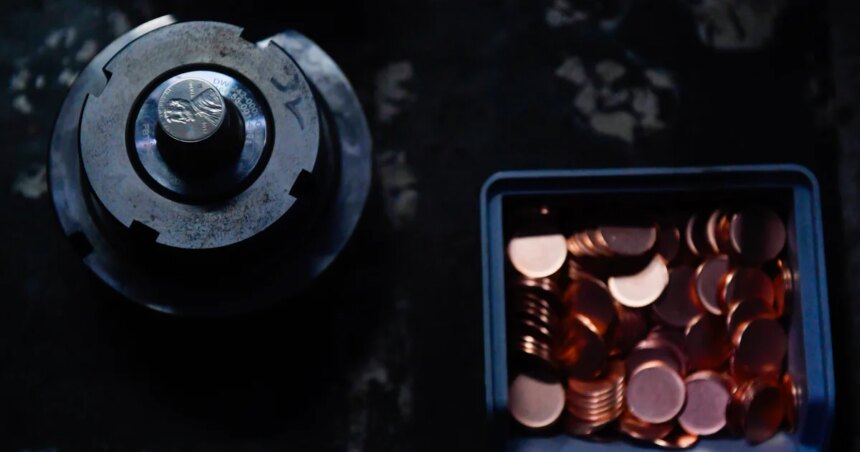
The U.S. Mint in Philadelphia has officially halted the production of circulating pennies as a directive from President Trump aimed at curbing rising production costs. This decision has significant implications for various retailers and service providers, as they navigate the challenges posed by a penny shortage.
In light of this development, McDonald’s has informed customers that, at some locations, cash transactions may not always yield exact change. Instead, prices will now be rounded to the nearest five cents. For instance, if an order totals $10.22, customers will pay $10.20, whereas a total of $10.23 will result in a payment of $10.25. Notably, digital and card payments will remain unaffected by this policy.
GoTo Foods, the parent company of several popular chains including Auntie Anne’s, Cinnabon, Jamba, and Carvel, has also responded by advising franchisees to round cash transactions in favor of customers. This approach follows a similar strategy employed by Wendy’s, which has instructed its restaurants to round down cash transactions to the nearest nickel whenever they experience a penny shortage. Both companies confirmed that their digital transaction systems remain seamless.
Kroger has taken a slightly different approach, encouraging customers to provide exact change when paying with cash, while still accepting pennies as a form of payment. Meanwhile, Kwik Trip, a convenience chain in the Midwest, has opted to round cash transactions down to the nearest nickel as a response to the ongoing shortage.
In Pennsylvania, Giant Eagle supermarkets introduced an innovative promotion, allowing customers to exchange their pennies for gift cards valued at double the coins’ worth. The supermarket chain views this initiative as a means to collect more pennies, thereby ensuring they can provide exact change in cash transactions. Giant Eagle expressed that this proactive measure will help maintain fairness and accuracy while awaiting federal guidance on proper rounding practices.
Sheetz, another chain in the convenience store sector, has encouraged customers to opt for cashless payments. However, in a unique promotion, one store offered a free drink to customers who brought in a dollar’s worth of pennies, showcasing the store’s attempt to creatively engage with patrons during this transition period.
As the U.S. grapples with the implications of penny production coming to a close, major chains are adapting their cash handling policies to ensure smooth operations while navigating this significant change in monetary circulation.