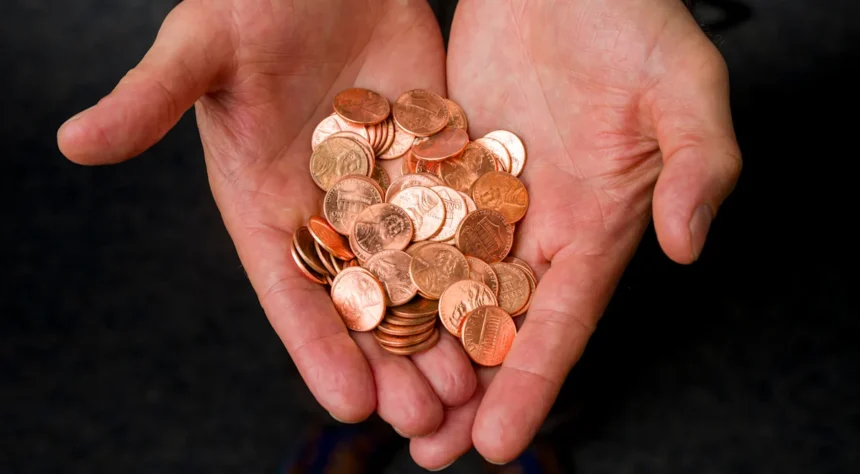
The U.S. Mint marked the end of an era on November 12, 2025, by stamping its final collection of pennies after 232 years of production. This decision followed an order from President Trump in February, intended to halt the minting of pennies due to rising production costs that outstripped the coin’s value. Each penny cost an astonishing 3.69 cents to produce, nearly four times its face value.
As sentiments shifted among consumers, many began to view pennies as bothersome coins, often discarding them instead of keeping them. However, following the announcement to cease penny production, a rush to collect the 2025 coins ensued, with some sellers listing boxes of these newly minted coins online for prices soaring to $1,000, despite their face value being only $25. Local radio stations even encouraged listeners to purchase 50-cent rolls of pennies from banks and resell them on platforms like eBay for exponentially inflated prices.
While the allure of these “collectibles” attracted numerous buyers, coin experts cautioned against investing in inflated penny prices. John Feigenbaum, executive director of the Professional Numismatists Guild, stated that scammers often emerge during high-interest periods related to coins, aiming to exploit the confusion among consumers. He estimated the mint had produced roughly a billion 2025 pennies before halting production, bolstered by an additional three billion minted in the previous year.
Feigenbaum emphasized that genuine collectible value isn’t reflected in the inflated prices seen online, recommending that consumers avoid overpaying for these coins. Historical trends echoed his warnings, particularly recalling the 1976 bicentennial quarter hype, where many individuals hoarded the redesigned coins, expecting significant future value. Decades later, those quarters remain worth little more than their face value due to their abundant supply.
Interestingly, a rare exception exists among the 2025 pennies. The U.S. Mint produced 232 special omega-marked pennies in Philadelphia and another 232 in Denver, intended to commemorate the end of the denomination alongside 232 gold versions. These unique coins are set to be auctioned in December, with anticipated prices ranging from $10,000 to $20,000 each. The final five pennies minted, also featuring omega markings, are expected to command a staggering $2 to $5 million at auction.
Looking to other countries, Canada discontinued its penny production in 2012, providing a glimpse into the future for U.S. coins. Pre-1997 Canadian pennies, primarily composed of copper, currently sell for about three cents each based on copper value. However, only copper pennies saw modest value appreciation over a decade, whereas U.S. pennies minted post-1982 are made up of 97.5% zinc and 2.5% copper plating, resulting in minimal worth as a commodity.
In a time of rising financial pressure for many Americans — with escalating grocery prices and housing costs — the perceived opportunity to profit from hoarding pennies may seem enticing. Yet experts caution that this avenue leads away from more effective wealth-building strategies. Emphasizing the efficacy of traditional investments, analysts point out that the S&P 500 yielded a remarkable 23% return in 2024, demonstrating significant growth over the past two years. In contrast, investing $100 in newly minted pennies would yield nothing but a nominal $1 in actual currency.
Amid the rising costs and economic challenges, it becomes clear that quick financial gain through collectible pennies may not be the solution consumers are seeking. Instead, more reliable investment opportunities exist that could ensure better long-term financial health.