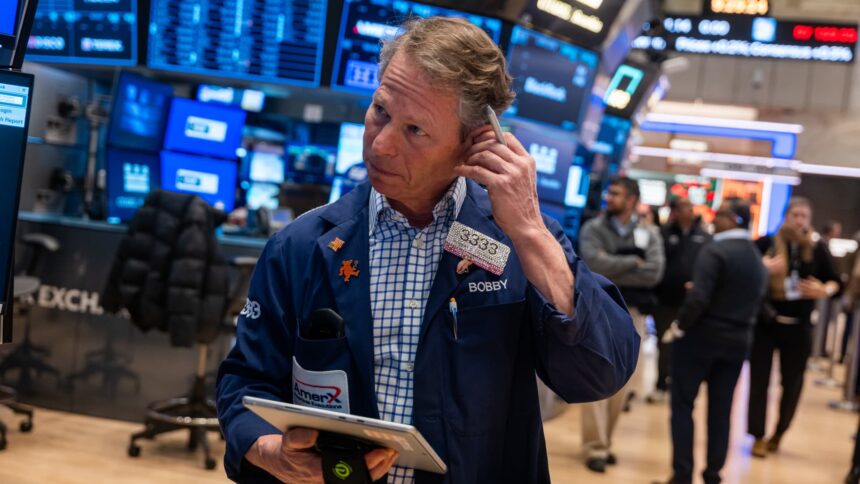
U.S. stock futures experienced a notable decline on Sunday night following President Donald Trump’s announcement of an increase in global tariffs from 10% to 15%. This decision was prompted by the Supreme Court ruling that struck down key elements of the president’s “reciprocal” tariffs. The shift in tariff policy has contributed to increased uncertainty in the markets, raising concerns over potential inflation and global economic growth.
The Dow Jones Industrial Average futures plummeted by 300 points, reflecting a drop of 0.6%. Similarly, S&P 500 futures fell by 0.7%, while Nasdaq 100 futures recorded a decline of nearly 1%. Additionally, oil prices took a hit, with Brent crude futures decreasing by 0.7% to reach $71.26 per barrel, and U.S. crude futures diminishing by 0.8% to $65.95 per barrel. The cryptocurrency market also felt the pressure, as Bitcoin’s value tumbled by 5%, dropping below the $65,000 mark amid a continued sell-off.
President Trump made his announcement on Saturday, indicating that the new tariffs would take effect immediately. However, it was unclear whether any official documents had been signed to confirm the timeline. Trump stated via social media, “I, as President of the United States of America, will be, effective immediately, raising the 10% Worldwide Tariff on Countries, many of which have been ‘ripping’ the U.S. off for decades, without retribution (until I came along!), to the fully allowed, and legally tested, 15% level.” The president hinted at the possibility of additional levies in the coming months, intensifying already heightened market anxieties.
The turbulence in the market comes after a volatile trading session on Friday, during which stocks initially rose in response to the Supreme Court’s ruling against Trump’s trade agenda but then faced pullbacks before recovering. The Dow ended that session more than 230 points higher, a gain of 0.5%, recovering from an earlier loss of 200 points. The S&P 500 and Nasdaq Composite also posted gains of 0.7% and 0.9%, respectively. Investor sentiment leaned towards optimism briefly following the Supreme Court ruling, which was seen as a possible easing of trade tensions and a sign that affected companies might expect some refunds. However, clarity from the White House remains elusive, leaving many in the market apprehensive.
Tim Holland, chief investment officer at Orion Wealth Management, remarked, “It would seem that Wall Street — and Main Street — are going to be dealing with the issue of trade and tariffs for some time to come,” underscoring the persistent uncertainty facing both investors and consumers.
In geopolitical developments, Iran continues to capture investor attention. Recently, Trump urged Iran to negotiate a deal over its nuclear program, cautioning that failure to do so could lead to “bad things.” The president is scheduled to deliver his State of the Union address on Tuesday, which is anticipated to cover a range of pressing issues.
Looking ahead, investors are particularly focused on Nvidia’s upcoming earnings report, set for release on Wednesday. As one of the few companies among the so-called Magnificent Seven stocks to have recorded any gains this year, Nvidia’s performance will be critical, especially in terms of reaffirming its commitment to an aggressive investment strategy in artificial intelligence.
Additionally, economic indicators are anticipated as durable goods orders and factory orders data are scheduled for release on Monday morning, adding another layer of interest for market participants.