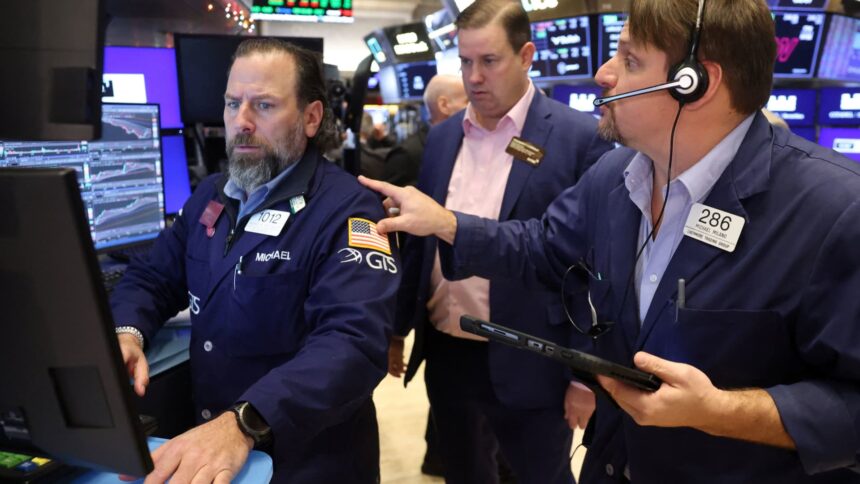
Traders on the floor at the New York Stock Exchange observed a slight rise in stock futures overnight, following a successful trading session where both the S&P 500 and the Dow Jones Industrial Average achieved all-time highs. Futures tied to the Dow reflected a modest increase of 24 points, equating to 0.07%. S&P 500 futures rose by 0.04%, and the Nasdaq 100 futures saw a similar increase of 0.07%.
In Tuesday’s regular trading session, investor confidence appeared resilient despite geopolitical tensions stemming from a recent U.S. attack on Venezuela. The Dow surged approximately 485 points, or 0.99%, surpassing the 49,000 mark for the first time. The S&P 500 also concluded the day with a record close after a gain of about 0.6%, while the Nasdaq Composite registered an increase of roughly 0.7%.
Market analysts noted that the reaction to the Venezuelan crisis exemplifies the disconnect between headline risks and actual market performance. Angelo Kourkafas, a senior global investment strategist at Edward Jones, pointed out that, despite Venezuelan President Nicolás Maduro’s arrest being significant in a geopolitical context, it does not bear immediate implications for oil supply—a critical factor for the markets. The sustained rally in stocks this week indicates a favorable economic environment, supported by anticipated earnings growth across various sectors, particularly beyond just mega-cap technology companies.
In terms of sector performance, nine out of the 11 S&P 500 sectors ended the session on an upswing. Health care and technology sectors played pivotal roles in propelling the index. Companies such as Amazon and Palantir, both considered favorites among retail investors, each experienced gains exceeding 3%. Data storage firms, including SanDisk, Western Digital, and Seagate, were among the top performers for the day.
Looking ahead, Paul Christopher, head of global investment strategy at Wells Fargo Investment Institute, emphasized the importance of “social calm” in influencing the direction of the U.S. stock market. He warned that if the current Venezuelan government fails to cooperate with the U.S., or if political opposition grows impatient waiting for elections, the country could descend into further social instability, which would likely negatively impact U.S. equities. Conversely, he suggested that if the U.S. could assist the Venezuelan populace in harnessing their oil resources and advocate for fair elections, it could foster stronger economic ties between the U.S. and Latin America, potentially benefiting U.S. markets in the long run.