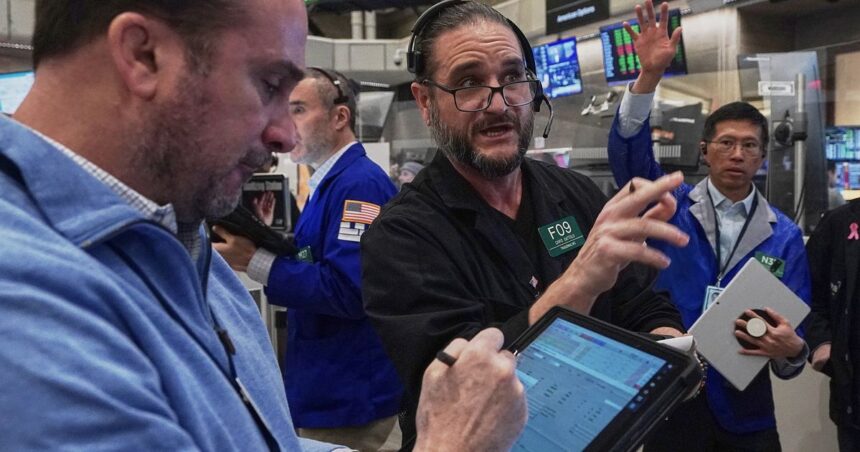
The U.S. stock market showed a downward trend on Friday, concluding a week marked by volatility and uncertainty. The S&P 500 index experienced a decline of 0.2%, positioning it for a second consecutive week of modest losses. The Dow Jones Industrial Average faced a drop of 252 points, or 0.5%, while the Nasdaq composite also fell by 0.1%.
Intel Corporation significantly influenced the market’s downturn, with its shares plummeting by 14.7%. Despite reporting better-than-expected results for the closure of 2025, the company’s forecast for the first quarter did not meet Wall Street’s anticipations. CFO David Zinsner pointed out that ongoing supply shortages are impacting the entire semiconductor industry, predicting that supply will reach its lowest point early this year before beginning to improve in the spring. Meanwhile, CEO Lip-Bu Tan emphasized potential opportunities stemming from advancements in artificial intelligence.
In comparison, the movements in U.S. bond and foreign-currency markets were more stable after recent fluctuations. Investor sentiment appeared to shift away from U.S. investments following President Donald Trump’s initial threats of implementing 10% tariffs on European countries that opposed his interests in Greenland. This led to a drop in U.S. Treasury bond prices, raising their yields, and a decline in the U.S. dollar’s value against foreign currencies.
However, after Trump announced a tentative deal regarding Greenland and rescinded the proposed tariffs, market recovery was noted, although specific details remain sparse. On a related note, gold prices continued their ascent, nearing $5,000 per ounce, reflecting a preference among investors for safer assets amid ongoing market uncertainties.
On Wall Street, Capital One Financial saw its stock decrease by 3.8% due to weaker-than-expected profits for the end of 2025. The company also disclosed plans to acquire Brex, a corporate card service provider, for $5.15 billion in cash and stock, overshadowing other aspects of its performance.
In contrast, SLB, an oil field services provider, enjoyed a 4.1% share price increase after surpassing analysts’ profit expectations for the latest quarter and announcing a 3.5% dividend hike. CEO Olivier Le Peuch noted that revenue improved across all four geographic segments for the first time since spring 2024.
CSX saw a rise of 3.7%, despite posting weaker profits than expected. Analysts pointed to the company’s optimistic forecast regarding its ability to retain operating profits from revenues in 2026.
In the bond market, the yield on the 10-year Treasury decreased slightly to 4.25% from 4.26% the previous day.
Internationally, stock markets exhibited mixed results in Europe, whereas many Asian markets had earlier shown gains. Japan’s Nikkei 225 index climbed by 0.3% after the Bank of Japan maintained its key interest rate, aligning with widespread investor expectations. The central bank had previously increased the rate to 0.75% in December and has been progressively adjusting it upward from a negative range.
Amid the week’s tumultuous events, global markets seemed to stabilize following a surge in Japanese government bond yields, initially triggered by concerns over potential fiscal measures from Prime Minister Sanae Takaichi that could exacerbate the nation’s substantial debt levels.