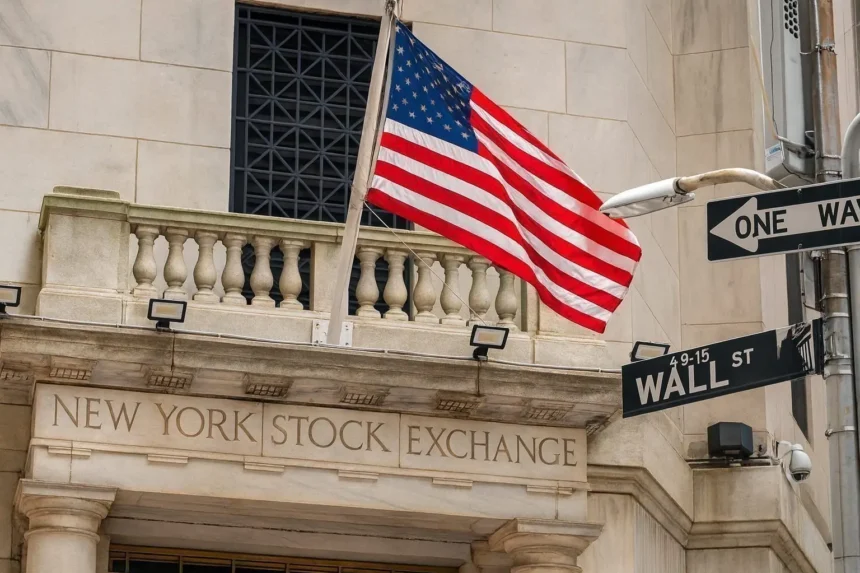
The U.S. stock market is navigating a mixed landscape as it approaches Friday trading. Dow futures are slightly up, while futures for the S&P 500 and Nasdaq are experiencing declines. This divergence signals investor recalibration concerning the costs and potential profitability of artificial intelligence (AI) expansion, following new insights from tech heavyweights Broadcom and Oracle.
In the early morning trading hours, Dow E-minis reported an uptick of 82 points, or 0.17%, while S&P 500 E-minis reflected a decline of 13.5 points, approximately 0.20%. The Nasdaq 100 E-minis experienced a more significant drop, down 142.75 points, equivalent to 0.56%. This mixed sentiment has been the week’s primary narrative, particularly after Thursday’s trading session saw record closes for both the Dow and S&P 500, contrasting with the Nasdaq’s underperformance.
The recent trading conditions underscore a market shift that extends beyond mega-cap technology stocks, although concerns regarding a potential AI bubble are surfacing. Investors now appear more discerning, weighing the quality of AI-related revenue against robust revenue forecasts. Broadcom’s latest guidance, which suggested impending margin pressures tied to increased AI-related business—especially system sales—prompted a nearly 5% premarket decline in its shares and similarly impacted other semiconductor stocks like AMD and Nvidia.
Oracle’s performance further intensified the scrutiny around AI spending. The company saw its shares plunge by as much as 16.5% following its announcement of a $15 billion uptick in capital expenditures for fiscal 2026, raising alarms about overspending on AI before materializing returns. Analysts indicate that this situation is feeding investor anxiety, as Oracle’s shift touches onto the broader theme of spending discipline within the AI investment landscape.
Despite these pressures, the S&P 500 ended Thursday at an all-time high, suggesting that money is still flowing into equities, albeit in a more selective manner. There was notable leadership rotation, as materials and financials drove gains while traditional tech stocks lagged. Interestingly, the Russell 2000 index, which tracks small-cap stocks, also hit a record high, indicating a broadening bullish trend in the market.
The Federal Reserve has played a crucial supporting role in the recent market dynamics, having enacted its third consecutive rate cut, with a notable projection of caution regarding future easing. While traders are pricing in an expectation for additional cuts into 2026, the Fed’s rhetoric has instilled a cautious atmosphere, influencing the current market’s rotational strategies rather than an overall surge.
With a significant lack of hard economic data stemming from a recent federal government shutdown, traders are on alert, preparing for the potential implications of delayed job and inflation reports. The intersection of thin holiday liquidity and high-stakes data releases has created a precarious environment for the market.
Looking ahead, several key stocks will be under scrutiny, including Broadcom and Oracle, whose recent results have sparked considerable investor conversation. Costco has garnered attention following a solid earnings report, while Lululemon is experiencing a bounce after announcing a leadership change. Additionally, cannabis stocks are seeing gains due to speculation around possible regulatory easing at the federal level.
As the Nasdaq prepares for its annual index reshuffle, traders will be keeping a close eye on potential changes to constituents, which could have substantial passive investment implications. The overall market sentiment reflects a narrative of rotation rather than retreat, emphasizing a growing sensitivity among investors to costs, margins, and the sustainability of AI-driven growth.
The current conditions suggest that while AI remains a significant growth engine, the next crucial phase will be dictated by economic health and earnings quality, particularly amid the uncertainty of upcoming economic data releases.