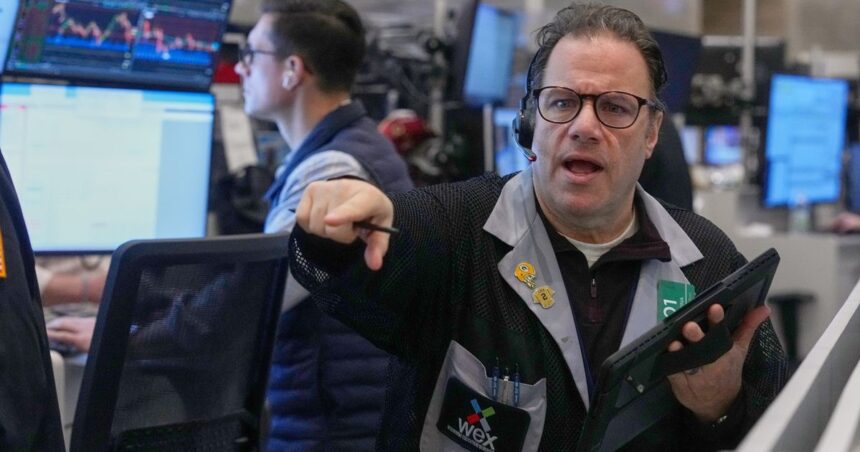
The U.S. stock market experienced a subdued closing on Tuesday, concealing notable volatility beneath the surface as discussions emerged about declining consumer confidence. The S&P 500 saw a modest increase of 0.1%, oscillating between a 0.5% gain and a nearly 1% loss throughout the trading day. The Dow Jones Industrial Average inched up by 32 points, equivalent to 0.1%, while the Nasdaq composite also reported a gain of 0.1%.
Leading the market’s positive movement was Paramount Skydance, which surged by 4.9% following news that Warner Bros. Discovery would allow it to present its “best and final” bid for the acquisition of the entertainment company—an attempt to outmaneuver a competing offer from Netflix. Warner Bros. Discovery also saw a rise of 2.7%, with Netflix gaining marginally at 0.2%.
Conversely, the market witnessed significant losses, particularly for General Mills, whose stock plummeted by 7% after the company expressed concerns about its customers’ unease. The producer of popular brands such as Cheerios, Nature Valley, and Pillsbury lowered its profit forecast for 2026, indicating sharper declines than previously anticipated. Surveys indicate widespread consumer uncertainty, attributed to persistent inflation, a job market recovering slowly, and ongoing concerns about tariffs.
In a similar vein, Genuine Parts, which specializes in auto and industrial replacement parts, reported weaker-than-expected quarterly results. The company announced plans to split into two public entities by early 2027, with one focusing on auto parts and the other on industrial parts; this news prompted a dramatic 14.6% drop in its stock.
Big Tech stocks also weighed heavily on the market, notably Alphabet, which fell by 1.2%. The fluctuations among these technology giants have been pronounced, especially as Nvidia’s stock alternated between significant losses and gains throughout the day.
Market analysts suggest that greater stabilization among major tech companies is necessary, advising a reduction in the volatile sell-first mentality apparent among investors. Last week saw turmoil when software companies faced backlash from investors, wary of potential challengers powered by AI technology encroaching on their markets.
Despite the overall high performance of the stock market, some investors have expressed uncertainty, especially in light of recent rapid sell-offs disrupting upward trends. Observers note that the market has shifted dramatically. Where AI previously spurred unprecedented growth, it now raises concerns about overinvestment in specific sectors. Companies heavily investing in AI technologies, such as Alphabet, face increasing pressure regarding the financial returns from substantial expenditures on data centers and chips.
A recent Bank of America survey highlighted growing apprehension among global fund managers about overinvestment risks, indicating potential future reductions in chip spending from major players like Nvidia.
Overall, the day concluded with the S&P 500 adding 7.05 points to reach 6,843.22. Meanwhile, the Dow Jones Industrial Average increased by 32.26 points to settle at 49,553.19, and the Nasdaq composite rose by 31.71 points, concluding at 22,578.38.
In the bond market, Treasury yields remained relatively stable, with the yield on the 10-year Treasury increasing slightly to 4.05% from 4.04% noted late Friday.
Internationally, European indexes rose following a lackluster trading day in Asia, where numerous markets were closed due to the Lunar New Year celebrations. Japan’s Nikkei 225 slipped by 0.4%, pressured by weak economic data and a significant 5.1% decline in shares of tech giant SoftBank Group. This drop followed a substantial rally triggered by favorable election outcomes that seemed to pave the way for the ruling party to implement pro-economic policies.