The U.S. stock market displayed a more stable demeanor on Tuesday, following a reminder of the potential benefits linked to the ongoing artificial intelligence (AI) technology boom.
In early trading, the S&P 500 experienced a slight decline of 0.2%, which followed a more significant drop of 1% the previous day. Meanwhile, the Dow Jones Industrial Average climbed 123 points, reflecting a 0.3% increase, as of 9:35 a.m. Eastern time, while the Nasdaq composite recorded a modest decrease of 0.2%.
Advanced Micro Devices (AMD) played a pivotal role in buoying the market, with shares rising by 6.8%. This surge was fueled by the announcement of a multi-year agreement to supply chips to Meta Platforms, aimed at bolstering Meta’s AI projects. The agreement also grants Meta the option to purchase up to 160 million shares of AMD stock for merely 1 cent each, contingent on the volume of chips Meta procures.
The renewed excitement surrounding AI is a reminder of its transformative potential, which industry experts believe could lead to a more productive economy. However, investor sentiment has recently shifted toward a more cautious perspective, focusing on the risks associated with AI technologies. Concerns have grown that numerous sectors—including software, trucking logistics, and legal services—might see their profitability threatened by the advancements in AI.
IBM saw a slight recovery on Tuesday, posting a 2.1% gain following a staggering 13.1% drop the day prior, marking its worst performance since 2000. This volatility reflects the broader anxiety gripping the market regarding potential disruptions caused by AI.
The private-equity sector is not immune to these concerns, with rising fears related to loans made to software companies that rely heavily on recurring revenue streams. Blue Owl Capital, for example, saw its shares fall by 1.2%, compounding its year-to-date losses to 31%.
Despite the tumult in AI-related stocks, many large U.S. companies continued reporting better-than-expected earnings for the end of 2025. Notably, Home Depot’s shares increased by 3.8% following the company’s announcement of stronger-than-anticipated profits and revenues, despite current consumer uncertainties as highlighted by CEO Ted Decker.
In another noteworthy development, Keysight Technologies surged by 18.1% after exceeding analyst expectations for both profit and revenue. The company also projected an impressive 30% revenue increase for the current quarter compared to the previous year.
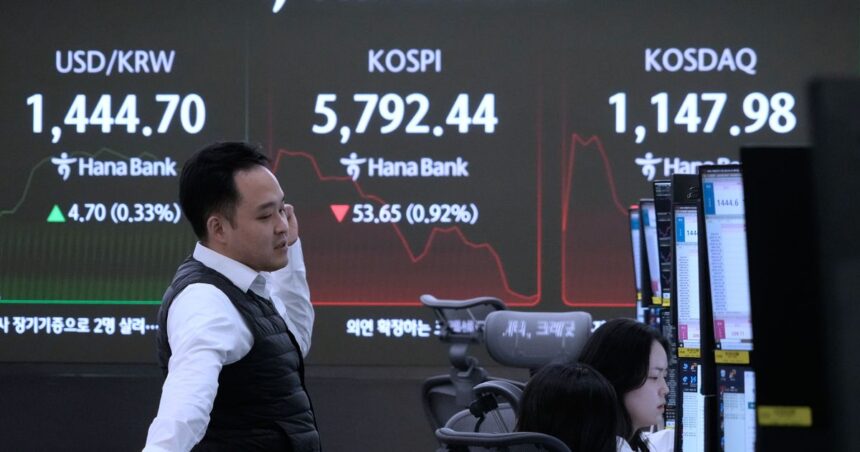
International markets mirrored mixed results, with European indexes showing modest movements. In the Asian markets, volatility was more pronounced; South Korea’s Kospi index rose by 2.1%, while Hong Kong’s Hang Seng index fell by 1.8%. Stocks in Shanghai registered a 0.9% increase following a lengthy holiday break.
On the bond market front, Treasury yields remained relatively unchanged, with the 10-year Treasury yield sitting steady at 4.03%, consistent with levels observed late the previous day.