U.S. stock markets experienced significant declines on a tumultuous trading day, as investor sentiment was dampened by fears surrounding the impact of artificial intelligence on various industries. The S&P 500 slipped 0.4%, closing at 6,878.88; the Dow Jones Industrial Average plummeted 521.28 points, settling at 48,977.92; and the Nasdaq composite dropped 210.17 to finish at 22,668.21.
The downturn was exacerbated by a disappointing update on inflation, with a reported 2.9% increase at the wholesale level, significantly higher than the 1.6% economists had anticipated. This report raises concerns that the Federal Reserve may need to reconsider its interest rate strategy, potentially delaying cuts that could have provided a much-needed boost to the economy and investment prices.
Adding to market unease were rising oil prices amid escalating tensions between the United States and Iran regarding the latter’s nuclear program. The price for a barrel of benchmark U.S. crude increased by 2.8%, reaching $67.02, while Brent crude rose 2.4% to $72.48 per barrel. This geopolitical instability raises fears of possible disruptions to global oil supplies.
The focus on artificial intelligence has led to intense scrutiny of companies perceived as vulnerable to technological disruption. Block, the parent company of Cash App and Square, announced it would reduce its workforce by nearly half, reflecting the deep changes AI tools are introducing across industries. While the announcement resulted in a 16.8% jump in Block’s stock—following a strong quarterly report—CEO Jack Dorsey highlighted a broader trend, suggesting that many companies are late to recognize the transformative impact of AI.
This wave of AI-related anxiety has been felt widely across the market. Software companies, notably Salesforce, saw declines despite reporting better-than-expected earnings, with Salesforce shares falling 2.3%. Private equity firms investing in software were also adversely affected, with Apollo Global Management experiencing a notable 8.6% drop.
Not all companies were negatively impacted; Netflix shares climbed 13.8% after retreating from a bid to acquire Warner Bros. Discovery’s studio and streaming operations, paving the way for Paramount to potentially take over. In contrast, shares of Warner Bros. Discovery fell by 2.2%, while Paramount’s rose by 20.8%.
In the bond market, the yield on the 10-year Treasury fell to 3.96%, reflecting increased investor anxiety and a shift towards safer assets. Treasury yields typically decrease when market volatility rises and investors seek stability.
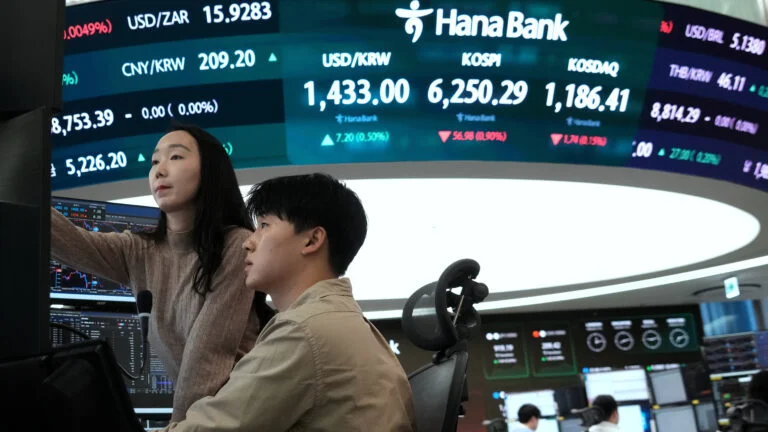
Internationally, stock indexes displayed mixed results. In Asia, South Korea’s Kospi fell 1%, while Hong Kong’s Hang Seng gained 0.9%. Many investors remain cautious as they monitor global economic indicators and geopolitical developments, reflecting an overarching sentiment of uncertainty in the broader financial landscape.