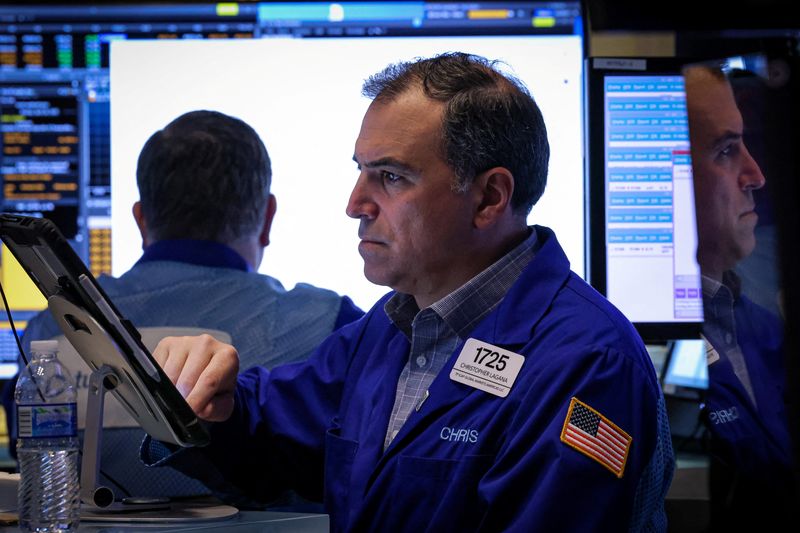
U.S. stocks faced a challenging session on Friday, reversing early gains to display a mixed performance amid heightened volatility following three consecutive days of market losses. The ongoing conflict in the Middle East continued to loom over investor sentiment, as oil prices fluctuated, reflecting the geopolitical tensions.
At 11:10 AM ET, the benchmark index saw a decline of 0.2%, settling at 6,658.91 points, while the tech-heavy index slipped 0.4% to 22,222.49 points. Meanwhile, the blue-chip index managed a slight uptick of 0.1%, standing at 46,712.98 points.
The previous trading day had already witnessed significant drops in the main averages on Wall Street, with both the S&P 500 and Dow Jones Industrial Average on a three-day losing streak. Investor confidence was shaken as the conflict involving Iran showed few signs of abating. President Donald Trump remarked that the U.S. is “totally destroying” Iran’s military capabilities and economy, asserting during a virtual meeting with G7 leaders that Iran was “about to surrender.” However, analysts downplayed the significance of these claims, highlighting that Tehran has made no indications of capitulation, with the new Supreme Leader, Mojtaba Khamenei, declaring the vital Strait of Hormuz would remain closed.
Despite apparent military advancements by the U.S. and Israel, some analysts suggested that Iran might be leveraging its control over shipping in the Strait as a countermeasure. To mitigate this, the U.S. Treasury announced the allowance of select purchases of sanctioned Russian crude until April 11. Furthermore, Defense Secretary Pete Hegseth stated that the U.S. had targeted over 15,000 enemy installations, claiming that Friday would witness a record volume of U.S. strikes in Iran.
These geopolitical tensions have significantly impacted oil prices, with Brent crude soaring above $100 a barrel amidst fears of a prolonged conflict in the oil-rich region. After experiencing extreme fluctuations earlier in the week, Brent had reached almost $120, before briefly dipping below $90. As of Friday morning, Brent crude futures had rebounded by 0.5% to $100.97 per barrel, on track for a weekly increase of nearly 7%.
Economically, Friday’s updates revealed a downward revision for U.S. GDP growth, now reported at an annual rate of 0.7% for Q4 2025, a notable reduction from the previous estimate of 1.4%. This revision highlighted a mixed investment landscape and the volatile nature of net exports, exacerbated by disruptions from the recent conflict. Moreover, the core personal consumption expenditures (PCE) price index rose by 0.4% month-over-month in January, aligning with expectations and reflecting a year-over-year increase of 3.1%, which remains significantly above the Federal Reserve’s 2% target. Economists caution that these figures are outdated, not reflecting the current inflationary pressures stemming from the Iran conflict.
In the jobs sector, new data revealed January job openings at 6.946 million, exceeding forecasts but slightly down from December figures, underscoring the ongoing trends in the U.S. labor market.
In individual stocks, Adobe shares dropped 6.5% after announcing the departure of its long-standing CEO, Shantanu Narayen, who has led the company since 2007 and oversaw its transformation to a subscription-based model. Despite this leadership change, Adobe reported strong quarterly earnings and provided optimistic guidance for the coming quarter. Conversely, stock dropped following a quarterly earnings miss and lackluster fiscal guidance for the cosmetics chain.
As the market navigates these turbulent waters, the combination of geopolitical instability and economic indicators is likely to maintain investor caution in the days ahead.