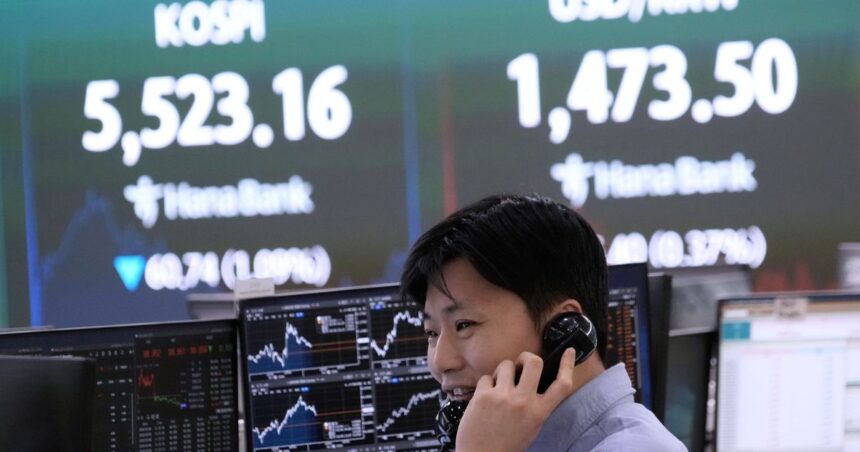
U.S. stock markets are experiencing notable declines as investors react to troubling economic signals, indicating a potential worst-case scenario involving a weakening economy alongside persistently high inflation. The S&P 500 has decreased by 1.3% following a report revealing that U.S. employers eliminated more jobs than they added last month. This decline coincides with a surge in oil prices, which have hit their highest levels in nearly two years due to escalating tensions related to the ongoing Iran war.
As of midday trading, the Dow Jones Industrial Average was down 632 points, reflecting a 1.3% loss, while the Nasdaq composite slid 1.1%. Market activity has been volatile, with the Dow initially plunging by as much as 945 points before slightly recovering. Investors are grappling with increased uncertainty linked to the conflict in the Middle East, amplifying the stock market’s erratic fluctuations.
Brian Jacobsen, the chief economic strategist at Annex Wealth Management, emphasized the severity of the situation, stating, “You can’t sugarcoat this report.” He highlighted concerns regarding the risks of stagflation—an economic condition characterized by stagnant growth coupled with high inflation. Further complicating matters, a separate report indicated that retail earnings for January fell short of economists’ predictions, suggesting that consumer spending may be nearing its limits.
In typical economic downturns, the Federal Reserve often lowers interest rates to stimulate growth. Lower rates can make borrowing for mortgages more affordable for households and provide companies with more accessible funding for expansion. The Fed had previously indicated a willingness to cut rates following multiple reductions last year. However, with the recent surge in oil prices, there’s a growing concern that more rate cuts could exacerbate inflation, putting the Fed in a difficult position.
Brent crude oil prices soared by 10.5% to $94.41 per barrel, reaching levels not seen since September 2023. U.S. crude prices climbed 14.1% to $92.30 per barrel, marking the first time they have exceeded $90 since early 2021. The rise in oil prices has been fueled by disruptions in critical oil-producing regions. Analysts have cautioned that if prices escalate further—especially to $100 per barrel and remain there—it could pose significant challenges for the global economy.
Historically, the U.S. stock market has demonstrated a capacity to rebound following conflicts, provided oil prices do not spike excessively or stay elevated for too long. Nonetheless, the current uncertainty regarding the trajectory of oil prices has resulted in unpredictable market movements, often fluctuating hour by hour.
In related news, President Donald Trump has recently signaled a desire for Iran to submit to “unconditional surrender,” seemingly ruling out the possibility of negotiations. In the bond market, Treasury yields fluctuated, with the yield on the 10-year Treasury initially rising to 4.19% before settling back to 4.12%, still above levels seen just a week prior.
Small companies, which often rely heavily on borrowing to fuel growth, are particularly vulnerable to high borrowing costs and the current economic climate. The Russell 2000 index, which tracks smaller stocks, fell by 2.4%, reflecting the heightened challenges they face.
The day’s trading showed a broad decline across the largest stocks on Wall Street, with over 80% of companies in the S&P 500 index experiencing losses. Companies heavily impacted by rising fuel costs were prominent among the decliners, with Old Dominion Freight Line dropping 7.4%, Norwegian Cruise Line Holdings decreasing by 4.9%, and Southwest Airlines falling by 6.8%.
Conversely, Costco Wholesale stood out as one of the few positive performers, climbing 1.5% after reporting stronger-than-expected profits for the latest quarter, benefiting particularly from a later Lunar New Year this year that boosted revenues from its international operations.
International markets also reflected this trend, with European indexes declining after a stronger finish in Asia, as France’s CAC 40 fell 0.7% and Germany’s DAX lost 0.9%. However, Hong Kong’s Hang Seng jumped 1.7%, and Japan’s Nikkei 225 rose by 0.6%.