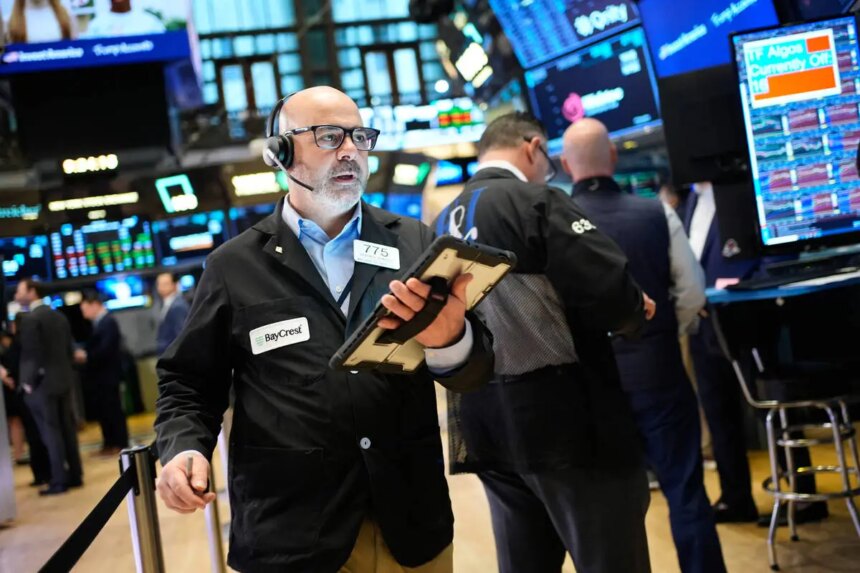
U.S. stocks faced significant declines on Friday as Wall Street wrapped up its fifth consecutive week of losses, marking its longest losing streak in nearly four years. The S&P 500 plummeted 1.7%, culminating in the worst week since the onset of the conflict with Iran. Meanwhile, the Dow Jones Industrial Average suffered a loss of 793 points, also down 1.7%, and fell over 10% from its recent peak. The Nasdaq composite decreased by 2.1%.
The week’s trading was characterized by volatility, as the stock market fluctuated between gains and losses daily, driven by fluctuating hopes regarding a potential resolution to the ongoing war. President Donald Trump sparked some optimism on Thursday evening by extending a self-imposed deadline to “obliterate” Iran’s power plants until April 6, contingent upon Iran’s compliance regarding oil tankers exiting the Persian Gulf through the Strait of Hormuz.
Following Trump’s announcement, oil prices experienced an initial decline, suggesting a temporary alleviation of tensions in the region. This mirrored relief seen earlier in the week, when oil prices dropped about 10% after he postponed the deadline.
However, despite the brief reprieve, oil prices began to rise again as the trading day progressed across various global markets. The situation remained tense, with ongoing fighting in the Middle East and Iran showing no indication of backing down. Israel’s threats to escalate military operations against Iran further fueled market anxieties.
Doug Beath, a global equity strategist at Wells Fargo Investment Institute, noted, “The diplomatic dissonance this week between the U.S. and Iran dismayed investors.” He emphasized that the cumulative uncertainty ultimately dampened risk appetite. Jim Bianco, president of Bianco Research, echoed this sentiment, stating that any forthcoming statements from Trump would likely be disregarded by the market unless they were accompanied by positive signals from Iran regarding negotiations.
The price of Brent crude oil surged by 3.4% to settle at $105.32 per barrel, a significant increase from approximately $70 prior to the onset of the conflict. Benchmark U.S. crude climbed 5.5% to reach $99.64 per barrel.
Concerns about the war’s potential disruption of the Persian Gulf’s energy sector persist, leading to fears of sustained inflation that could significantly impact the global economy. Such disruptions might not only drive gasoline prices higher but could also force businesses reliant on transportation to increase their prices, and result in higher electricity costs from gas-fired power plants. Analysts from Macquarie noted that if the war extends through June, oil prices could potentially soar to $200 per barrel, surpassing the previous record of $147 set in 2008 amid geopolitical tensions and strong oil demand.
The conflict and rising oil prices are contributing to a decline in consumer confidence in the U.S., an essential factor in the overall economy. According to a recent survey from the University of Michigan, consumer sentiment dipped more than anticipated in March compared to February.
On Wall Street, most stocks recorded losses, with three out of four constituents in the S&P 500 declining. The index now stands 8.7% below its all-time high reached in January. Major technology stocks were hit particularly hard, with Amazon and Meta Platforms both falling 4%, while Nvidia decreased by 2.2%. Companies in non-essential consumer goods also experienced declines, with Norwegian Cruise Line Holdings down 6.9%, Starbucks 4.8% lower, and Chipotle Mexican Grill slipping 4.1%.
By the end of the trading day, the S&P 500 was down 108.31 points to settle at 6,368.85, while the Dow Jones fell 793.47 points to close at 45,166.64. The Nasdaq composite ended the day with a loss of 459.72 points, finishing at 20,948.36.
International stock markets mirrored the trend, with European indexes declining after a mixed finish in Asia.
In the bond market, where Treasury yields are closely monitored for signs of economic health, notable fluctuations occurred. The yield on the 10-year Treasury briefly rose as high as 4.48% before settling at 4.43%, marking an increase from 4.42% late Thursday and significantly higher than the 3.97% recorded before the start of the conflict. The rising yields have already contributed to increases in rates for mortgages and other household and business loans, which could further slow economic growth.
Trump has previously cited high Treasury yields and disruptions in the bond market as significant factors influencing his policy decisions, leading critics to claim he often retreats from hardline stances when faced with financial discomfort among the public.