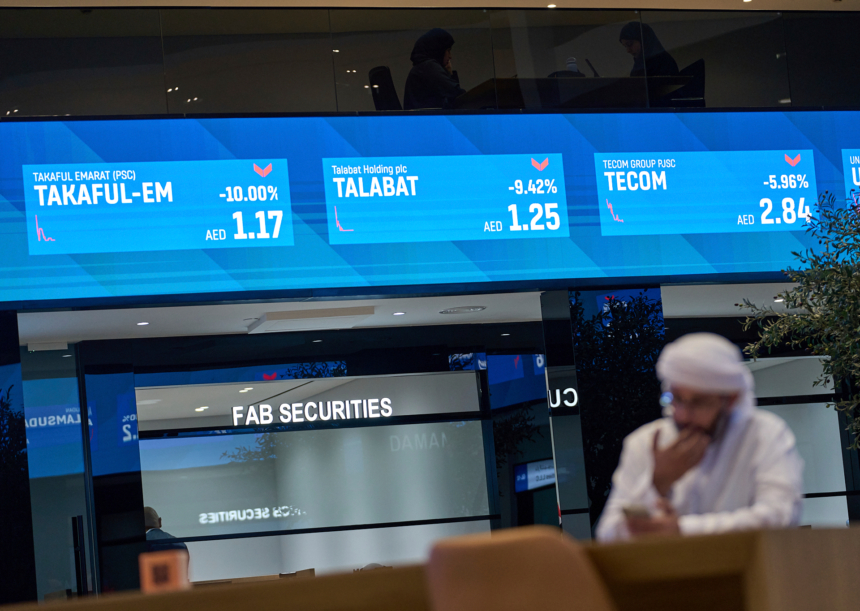
The stock markets in the United Arab Emirates, particularly in Dubai and Abu Dhabi, have faced a staggering decline, losing approximately $120 billion in value since the onset of the US-Israel war against Iran that began on February 28. This downturn has placed the UAE among the most adversely affected financial markets globally, with the Dubai Financial Market (DFM) General Index experiencing a decline of about 16 percent and the Abu Dhabi Exchange (ADX) down by around 9 percent.
Specifically, the DFM has seen a decrease in market capitalization of nearly $45 billion, while the ADX has lost about $75 billion. In contrast, financial markets in neighboring Qatar and Bahrain have dropped by approximately 4 percent and 7 percent, respectively. Interestingly, markets in Saudi Arabia and Oman have recorded gains during this turbulent period. The benchmark S&P 500 on Wall Street has also seen a decline, dropping around 7 percent, amid mixed signals from U.S. President Donald Trump regarding the war’s duration and aims.
While the UAE has been relatively insulated from global energy shocks, particularly in light of Iran’s closure of the Strait of Hormuz, the conflict has significantly impacted its status as a regional travel hub. The war has led to the cancellation of tens of thousands of flights, particularly affecting Dubai International Airport, which holds the title of the busiest airport for international passengers. This disruption poses a direct threat to the tourism and travel sectors, which contributed approximately $70 billion to the UAE’s economy last year, accounting for 13 percent of the nation’s gross domestic product.
Experts are interpreting the financial decline with cautious optimism. Haytham Aoun, an assistant professor of finance at the American University in Dubai, noted that while the drop in stock markets presents a significant challenge to investor sentiment, it should be viewed as a temporary shock rather than an indication of structural economic damage. He emphasized that international financial centers are assessed based not only on market performance during crises but also on regulatory quality, liquidity management, and institutional resilience.
Despite the current setbacks, UAE stock markets are deemed relatively small compared to global counterparts; significant investments have been made in financial services as part of broader economic diversification efforts. As of 2024, the value of UAE-listed stocks surpassed $1 trillion, positioning the UAE second only to Saudi Arabia in the region.
Furthermore, Dubai’s standing in the global financial landscape has been bolstered, rising to seventh place in the recent Global Financial Centres Index, its highest ranking to date. The UAE’s leaders have set an ambitious goal for Dubai to emerge as one of the world’s top four financial centers by the year 2033, under a 10-year economic plan unveiled in 2023.
Burdin Hickok, a professor from New York University and former Middle East official, expressed confidence that a serious rebound in the Dubai and Abu Dhabi exchanges is likely following a resolution to the ongoing war. He reassured that the fundamental attractiveness of both stock markets remains intact, signifying that current volatility should not be seen as a major departure from their established potential.