









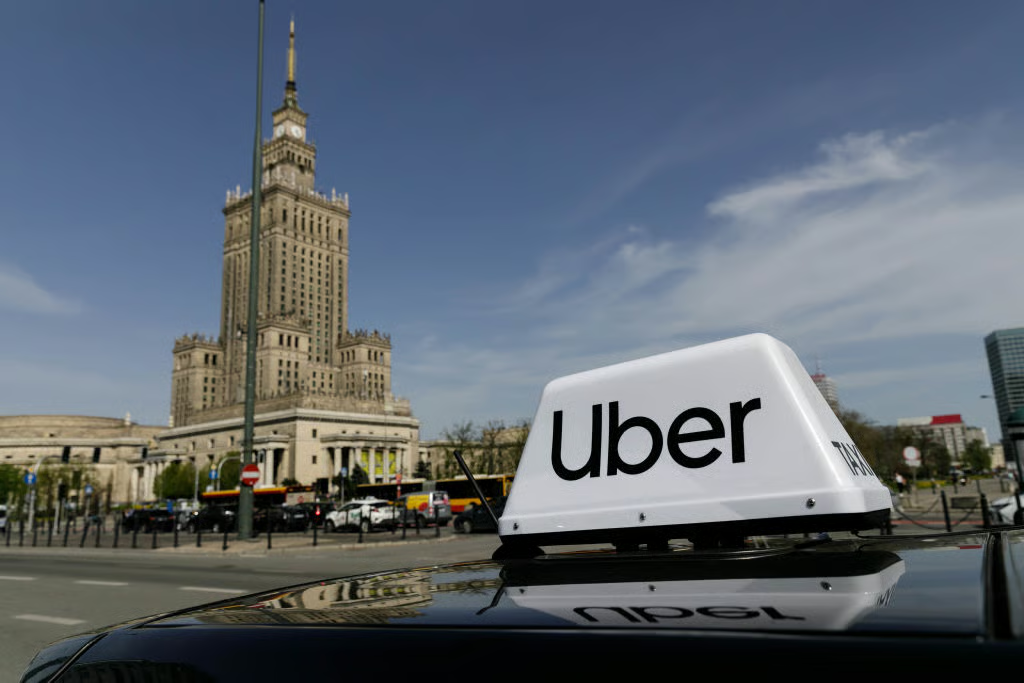
In a landscape where few stocks can truly be deemed as “forever stocks,” Uber is emerging as a frontrunner in the investment arena. As the global leader in the rideshare market, the company has established a dominant brand presence and adapted to evolving consumer needs. Despite facing challenges similar to other stocks, Uber’s unique positioning makes it stand out.
Uber leads the way in ridesharing, although it currently trails behind DoorDash in the U.S. food delivery sector. However, the Uber Eats division brings in higher global revenues than DoorDash, illustrating its strength and reach. The platform fulfills dual roles by providing a means for drivers to earn income while offering convenience to those seeking transport or meals. This behavioral shift is particularly striking in a car-dependent society like the U.S., where some individuals are opting for ridesharing instead of car ownership. This trend may be further amplified by the anticipated rise of autonomous vehicles, with Uber strategically partnering with automotive giants and tech firms to foster advancements in self-driving technology. Rather than owning the vehicles itself, Uber plans to optimize its service by facilitating matches between riders and available autonomous cars, creating a new revenue stream and solidifying its position in the transportation ecosystem.
Financially, Uber is showing promising signs of growth. In the first nine months of 2025, the company reported nearly $38 billion in revenue, an 18% increase year-over-year. Importantly, revenue growth outpaced rising costs and expenses, aided by a significant income tax benefit. As a result, Uber’s net income soared to $9.8 billion during this period, illustrating a substantial leap from the previous year’s earnings.
While uncertainties surrounding macroeconomic conditions and regulatory pressures could impede growth—especially debates around classifying Uber drivers as employees—gross bookings continue to trend upward, and the stock price has risen over 30% in the last year despite these concerns. Currently, Uber’s stock is trading at approximately $81.35, with a market capitalization of $169 billion. The forward price-to-earnings (P/E) ratio stands at a lower-than-average 19, suggesting that the stock may be undervalued when compared to the S&P 500 average of 31.
As an investor, the strong market leadership, innovative approach towards autonomous driving, and impressive revenue trajectories position Uber as a stock worth holding onto for the long term. While no stock is completely risk-free, the company’s continued relevance in ridesharing and delivery, coupled with its low valuation, suggests that Uber could yield significant returns for investors in the years ahead.