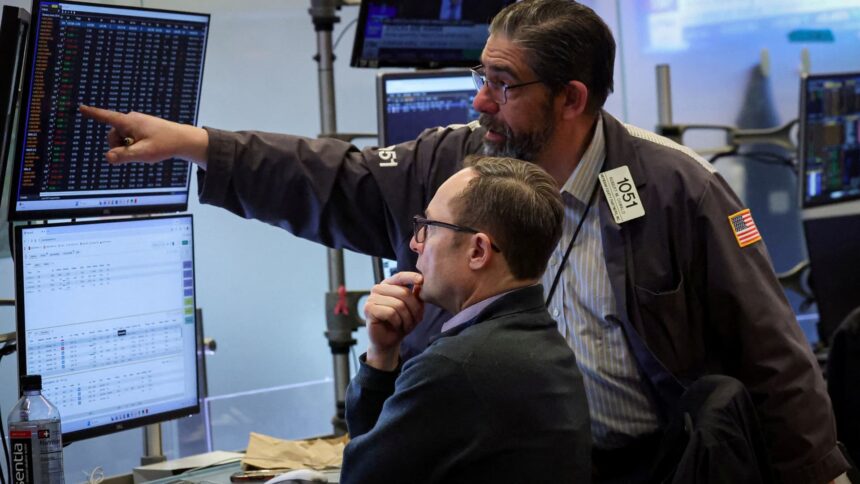
Traders on the floor of the New York Stock Exchange (NYSE) are bracing for potential shifts in the market following a notable downgrade of U.S. equities by UBS’ top equity strategist. Andrew Garthwaite, the head of global equity strategy at UBS, has reassessed the outlook for American stocks, now categorizing them as “benchmark” within a fully invested global equity context. He cites multiple rising risks that are undermining the factors which have historically driven U.S. equities to outperform.
A key concern highlighted by Garthwaite is the weakening U.S. dollar. UBS forecasts that the euro will climb to $1.22 by the end of the first quarter, predicting “asymmetric structural downside risks” for the dollar. Historically, a 10% decline in the trade-weighted index of the dollar has led to a rough 4% underperformance in U.S. equities—especially in unhedged terms. Recent trends confirm this, as foreign markets outperform their U.S. counterparts. For instance, the MSCI World ex-U.S. index has surged around 8% in 2026, while the S&P 500 remains largely stagnant. Other indices such as Japan’s Nikkei 225 and the Stoxx Europe 600 showcase impressive gains of 17% and 7%, respectively, further indicating a significant shift in investment focus away from American equities.
Investor apprehension is also prevalent as doubts about the long-term prospects of artificial intelligence advancements converge with persistent inflation concerns domestically. The tension has already contributed to a decline in stock prices as investor sentiment shifts.
Another critical factor affecting U.S. stock strength is the diminishing impact of corporate buybacks. Garthwaite notes that the buyback yield is now roughly congruent with global standards, which undermines what had been a significant driver of earnings per share growth and capital inflow. The combined shareholder yield from dividends and buybacks in the U.S. is reportedly around half that of Europe, which raises further alarms for investors looking at potential returns.
Valuation metrics also signal unease in the U.S. market. UBS reports that the sector-adjusted price-earnings ratio for U.S. stocks is approximately 35% higher than that of international counterparts, compared to a historical average premium of 4% since 2010. Alarmingly, around 60% of sectors in the U.S. not only trade at higher multiples than global peers but also exceed their historical averages.
Additionally, Garthwaite points to policy volatility under the Trump administration as a complicating factor. This year has witnessed several shifts in tariff policies, proposals regarding credit card interest rates, potential restrictions on private equity investments in housing, and renewed scrutiny of drug pricing, alongside discussions on curbing corporate dividends and buybacks in defense-related companies.
Despite these concerns, Garthwaite has stopped short of taking a bearish stance on U.S. equities. He notes that historically, the U.S. economy and its markets tend to gain more relative benefits during the early stages of a potential bubble. Moreover, UBS predicts that the adoption of artificial intelligence will surpass that of most other major regions, aside from China, which may help sustain earnings growth in critical sectors.
In terms of market outlook, UBS strategist Sean Simonds has set a year-end target of 7,500 for the S&P 500. This is somewhat below the average forecast of 7,629 compiled from 14 leading strategists, indicating a cautious tone amidst evolving market dynamics.