Many traders engage with Chainlink (LINK) like they would with any mid-cap altcoin: they examine the charts, take positions, and hope for a conducive macro environment. However, this strategy overlooks a crucial aspect of LINK’s price movement—its role as infrastructure for decentralized finance (DeFi) protocols. Unlike meme coins that rise purely on speculation and plummet as retail interest wanes, LINK’s price behavior is intricately linked to DeFi activities, protocol integrations, and overall trends in the cryptocurrency market.
This connection creates unique trading patterns that do not lend themselves easily to directional trading strategies. Instead, those patterns are more suited to a Futures Grid trading strategy, which focuses on capturing price movements within a defined range rather than forecasting ultimate price outcomes.
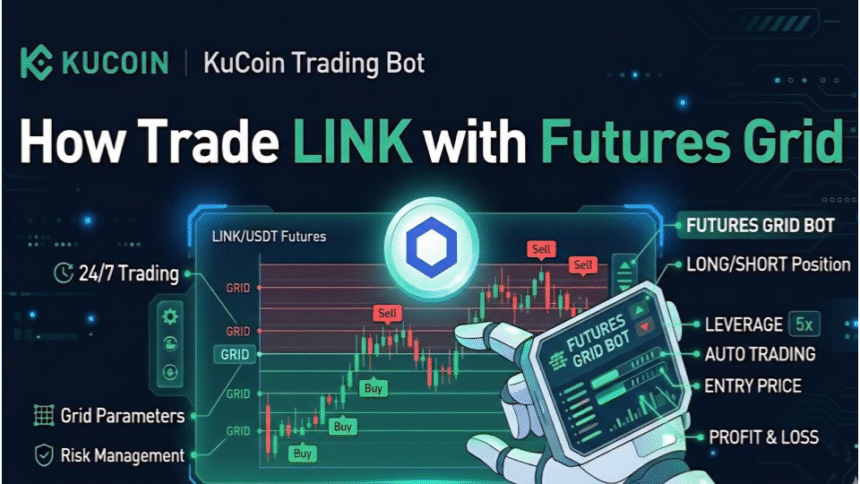
In a Futures Grid trading setup, traders do not simply take a single directional position on LINK. Instead, the trading bot places a series of buy and sell orders spanning a designated price range. Whenever LINK declines in value, the bot buys; conversely, when LINK appreciates, the bot sells. This automated method generates profit from the spread between buy and sell orders over time, allowing for returns even in sideways markets.
Understanding LINK’s price structure is the foundation of any effective grid trading strategy. LINK’s price is particularly sensitive to the dynamics of the DeFi ecosystem. As DeFi activity increases—whether through new protocols launching or overall total value locked (TVL) rising—LINK’s utility and, consequently, its price tends to increase. Conversely, during market downturns, LINK often reacts swiftly to negative events, sometimes outpacing broader market shifts.
This volatility is distinctive; LINK maintains a baseline level of oscillation even in quieter market conditions, driven by continuous underlying DeFi activity. Thus, a Futures Grid trading strategy can effectively harness this raw material of oscillation for recurring profits.
LINK’s price experiences sharper moves in response to protocol integration announcements and DeFi expansions. Such events typically follow a predictable sequence: an initial buildup in community discussions, the announcement itself, a subsequent price surge, and then a retracement where profits can be captured through grid trading.
While LINK can be traded using various methods, including spot trading or perpetual contracts, each approach has its advantages and drawbacks. Spot holding is straightforward; however, it can lead to capital stagnation during periods of range-bound movement. Conversely, perpetual contracts allow for leveraged trading but require precise timing, which can be challenging given LINK’s volatility.
Futures Grid trading stands out because it offers both leverage and the ability to profit in rising and falling markets. The strategy excels particularly during sideways or moderately volatile periods, enabling traders to extract profits from rapid price fluctuations without needing to predict where LINK’s price will ultimately land.
Key market catalysts for LINK’s price movements include protocol integration announcements, phases of DeFi TVL expansion, and broader market correlations, particularly with Bitcoin. Recognizing these factors allows traders to position their grids strategically in response to anticipated price movements.
To effectively configure a Futures Grid trading bot, traders must define critical parameters. For example, if LINK is valued at $14.50 and a trader expects it to fluctuate between $12 and $17 over several weeks, they could set up a grid with twelve levels of buy and sell orders spanning this range while using leverage to increase their effective trading capital.
However, every trading strategy carries inherent risks. Specific risks associated with LINK include the potential for contagion events in the DeFi space, smart contract failures, and leverage-related liquidation concerns. Proper risk management requires careful consideration of price ranges and maintaining adequate liquidation buffers.
Setting up a Futures Grid bot on the KuCoin platform is a straightforward process involving several steps, such as choosing between auto or custom configurations, defining parameters, and monitoring performance post-launch.
Ultimately, Chainlink’s price behavior reflects broader DeFi activity cycles, making it a unique asset for Futures Grid trading. When executed with a well-planned approach, this strategy can capitalize on LINK’s natural price oscillations and yield consistent returns. However, traders must remain adaptable to changing market conditions and stay informed about potential risks associated with their chosen strategies.