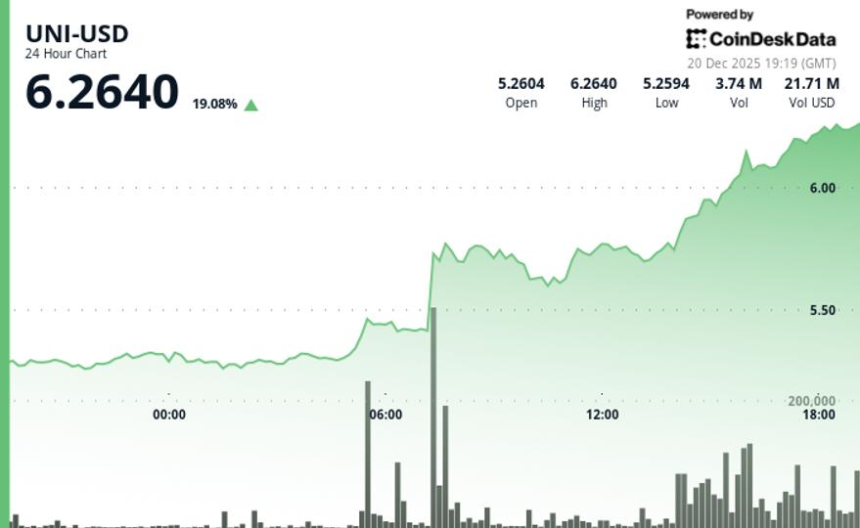
Uniswap’s UNI token experienced a significant rally of approximately 19% within a 24-hour span, coinciding with the commencement of on-chain voting on a pivotal governance proposal aimed at implementing protocol fees and a long-anticipated token burn mechanism.
According to Uniswap governance data, UNI began its ascent shortly after the voting period opened at 03:50 UTC on December 20. A review of the one-day UNI-USD chart, sourced from TradingView, reveals that the most considerable price surge occurred during the early hours of the voting window. The token broke out of the $5.40–$5.50 trading range and continued to rise throughout the day, accompanied by increasing trading volumes. By approximately 19:30 UTC, UNI had climbed to around $6.27, reflecting a notable 19% increase. This rise is especially remarkable given the relatively subdued performance of the broader market, where Bitcoin hovered around $88,300 and Ether experienced a slight decline to around $2,976. The overall cryptocurrency market capitalization saw a modest increase of about 1% during the same timeframe, highlighting UNI’s impressive market outperformance.
Central to the voting is a comprehensive governance proposal dubbed “Unification,” aptly named to signify the efforts to harmonize Uniswap’s economic incentives, governance structures, and development initiatives within a unified framework. If ratified, this proposal would see the implementation of protocol fees across Uniswap v2 and selected v3 liquidity pools, channeling these fees into a mechanism designed to burn UNI tokens.
The proposal also contemplates a retroactive burn of 100 million UNI tokens drawn from the treasury, a move aimed to approximate what might have been burned had protocol fees been in play since the early days of Uniswap. Furthermore, the initiative includes directing Unichain sequencer fees into the burn mechanism and developing new auction-based systems intended to internalize miner extractable value (MEV) while simultaneously enhancing returns for liquidity providers.
In addition to activating the fees, the proposal seeks to establish a tighter operational alignment among Uniswap Labs, the Uniswap Foundation, and on-chain governance. The outlined plan would enable Uniswap Labs to concentrate on protocol development and growth while removing fees from its interface, wallet, and API. Development and ecosystem initiatives would be sustained through a governance-approved growth budget.
Despite having debated the activation of protocol fees for years, previous attempts have stalled due to regulatory uncertainties and disagreements regarding incentive structures. The initiation of formal on-chain voting seems to have reignited market interest, with traders positioning themselves for the potential benefits associated with the value created by Uniswap’s leading trading volumes.
Initial voting data indicates overwhelming support for the proposal; however, the voting remains open until 6:14 p.m. UTC on December 25. Although the outcome is still pending, the timing of UNI’s rally suggests that the market is reacting positively to the governance process itself and the prospect of a structural change in value distribution for UNI holders.