




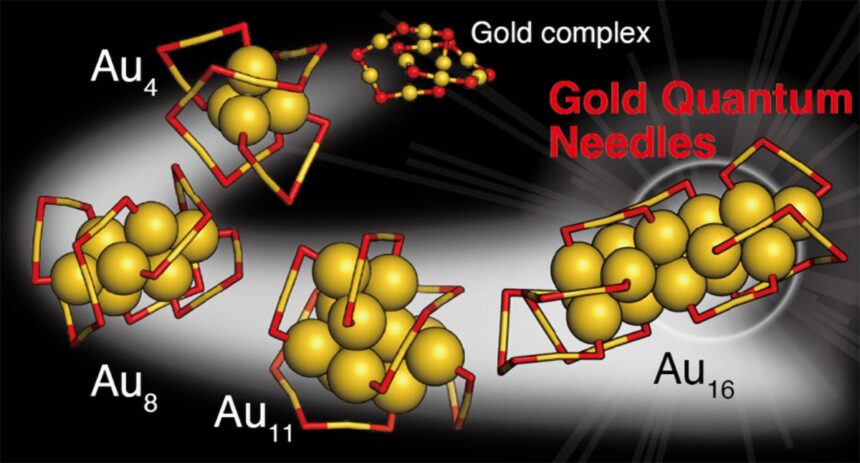
Researchers at the University of Tokyo have made significant strides in understanding the structural evolution of gold nanoclusters, demonstrating how atomic arrangements develop during the initial growth stages. Their groundbreaking work, recently published in the Journal of the American Chemical Society, reveals the emergence of a novel elongated structure, referred to as “gold quantum needles,” which could have promising applications in biomedical imaging and light-energy conversion.
Led by Shinjiro Takano, Yuya Hamasaki, and Tatsuya Tsukuda, the study delves into the complexities of gold nanocluster formation, a topic that has largely remained elusive in the field of nanotechnology. Gold nanoclusters, typically consisting of fewer than 100 atoms, possess unique properties that make them invaluable in various technological applications. However, controlling their size, shape, and composition has proven challenging due to the intricate nature of their formation processes.
In an effort to unveil the “black box” of cluster formation, Tsukuda and his team employed slightly unconventional synthesis conditions to capture nanoclusters at their nascent stages of growth. Utilizing single-crystal X-ray diffraction analysis, the researchers discovered that these nanoclusters grow anisotropically, meaning they develop at varying rates in different directions.
The team’s analysis further led to the identification of an unexpected structure—pencil-shaped nanoclusters made up of triangular trimers and tetrahedral tetramers. This discovery was particularly noteworthy as the researchers observed that electrons confined in these structures exhibited quantized behavior, which aligns with quantum mechanical principles. The discovery of the gold quantum needles was characterized as serendipitous, evolving from the team’s attempts to understand smaller nanocluster formations.
The new insights gained from this research not only contribute to the theoretical understanding of gold nanocluster formation mechanisms but also open avenues for refining synthesis methods to create other unique nanostructures. Tsukuda has expressed interest in collaborating with other experts to further explore the applications of gold quantum needles, particularly capitalizing on their exceptional optical properties.
This study highlights the transformative potential of gold nanoclusters in advanced technological applications, reflecting the ongoing innovation in nanotechnology research. As the team pushes forward, their work could lead to significant enhancements in the fields of biomedical imaging and energy conversion, showcasing just how pivotal the structural nuances of these nanomaterials can be.