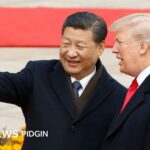
For a brief period, the relationship between China and the United States appeared to be improving, marked by a significant phone conversation between U.S. President Donald Trump and Chinese President Xi Jinping on September 19. This call came after months of silence and was only the second confirmed dialogue since Trump took office in January. Initial signs indicated a potential stabilization of relations.
Earlier in the year, trade tensions escalated dramatically, with U.S. tariffs on Chinese goods soaring to 145% while China’s tariffs on U.S. products reached 125%, effectively crippling trade between the two countries. However, in May, a cautious optimism emerged as tariffs were reduced and China began easing its restrictions on the export of rare-earth elements.
Trump had initially granted China a 90-day window for negotiations, which was later extended and included multiple rounds of talks in Europe. This led to renewed hope for reconciling trade differences. Unfortunately, that optimism did not endure.
In a concerning development, China announced new export controls on vital supplies of rare earths and critical minerals. These materials are fundamental to producing technologies ranging from smartphones to military equipment. As the dominant player in this sector, controlling 90% of global rare earth processing and 70% of the supply, China is strategically leveraging these resources in its trade competition with the U.S. President Trump has similarly prioritized securing access to these essential minerals, eyeing partnerships with nations such as Canada, Greenland, Ukraine, the Democratic Republic of the Congo, and Australia.
China’s move to restrict access to critical minerals is seen as a direct attempt to exert pressure on the U.S. market. Over the past two years, China has gradually escalated its export controls and restrictions on rare earth elements. In response, the U.S. has demonstrated its ability to limit China’s access to advanced semiconductor technologies, essential for modern electronics.
The announcement of new Chinese export controls prompted a swift reaction from Trump, who threatened to impose an additional 100% tariff on Chinese imports starting November 1, or possibly sooner. Furthermore, he suggested that a planned meeting with President Xi at the upcoming Asia-Pacific Economic Cooperation (APEC) summit in South Korea may be scrapped.
This latest turn of events has drawn the U.S.-China trade relationship back to a precarious state, leaving both markets in uncertainty. As dynamics shift rapidly based on the decisions of a single leader, observers are left wondering what the next chapter in this tumultuous relationship will hold.