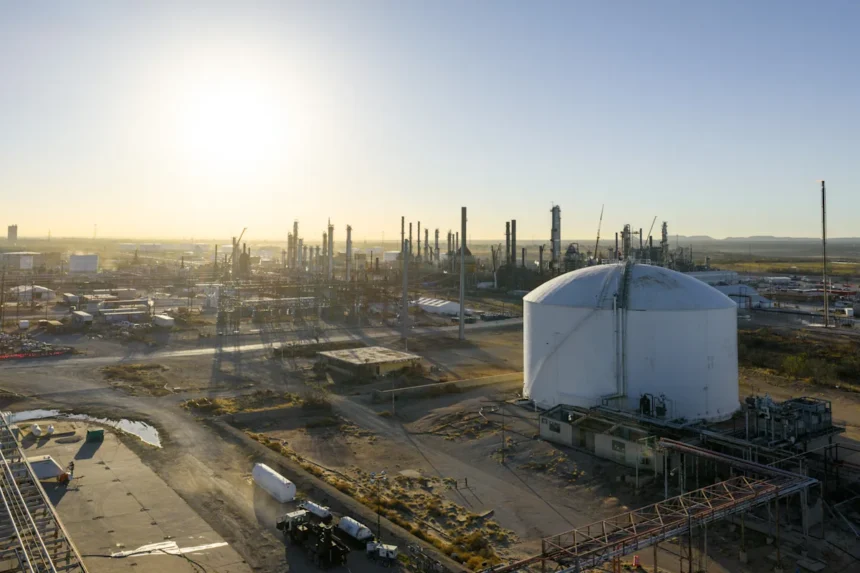
US stock futures experienced a decline on Friday, indicating a challenging week for investors, amid rising oil prices and ongoing geopolitical tensions related to the US-Israeli conflict involving Iran. Contracts for the Dow Jones Industrial Average and the S&P 500 both fell by approximately 0.6%, while futures for the Nasdaq 100 dropped 0.8%, suggesting further difficulties after Wall Street closed lower the previous day.
The market downturn is being influenced by reports revealing that the Trump administration may be considering military actions including an occupation or blockade of Kharg Island, a crucial hub for Iran’s oil exports. Such strategies are seen as attempts to pressure Tehran into reopening the Strait of Hormuz for crude oil tanker transit.
In response to these developments, oil prices shifted upward, continuing their rally despite efforts by the US and Israel to reassure markets regarding supply stability. Brent futures rose 1.2%, surpassing $109 per barrel, while West Texas Intermediate prices increased slightly above $96. Analysts caution that ongoing attacks from Iran on neighboring Persian Gulf states could maintain elevated oil prices, intensifying worries within the market.
With these dynamics, major US stock indices are on course for their fourth consecutive weekly decline. The Dow and Nasdaq Composite are nearing correction territory, sitting approximately 8% below their recent peaks, while the S&P 500 is nearly 5% off its all-time high.
In other market movements, Tegna stock surged by 9% in premarket trading following Nexstar’s announcement that it has completed the acquisition of Tegna, resulting in a consolidation of two leading television station ownership groups in the United States.
Cheniere Energy saw its stock rise by 2% amid concerns surrounding the escalating tensions in the Middle East, particularly after Iran targeted a significant liquefied natural gas facility. Dell Technologies also enjoyed a gain of over 2%, with a year-to-date increase of 24%, fueled by growth in its AI server division. Meanwhile, Unilever’s stock climbed 1% as the company negotiated a potential sale of its food business to McCormick & Co., marking a significant transformation.
On the downside, shares of Supermicro plunged over 20% following news that a co-founder faced charges for smuggling Nvidia-powered servers to China, which violates AI technology export restrictions. Supermicro plays a crucial role in AI server assembly and represents about 9% of Nvidia’s revenue.
In other notable movements, FedEx’s stock jumped 8% after the company raised its full-year sales projections, attributed to an increase in revenue and package yields in its fiscal third quarter.
Market analysts are also preparing for a significant $5.7 trillion “triple-witching” event on Friday, which could further influence trading dynamics. Meanwhile, Alibaba has set a bold goal of generating $100 billion in AI revenue, reflecting the increasing relevance of artificial intelligence in global business strategies.
As these events unfold, gold is on track to experience its largest loss in six years, highlighting a complex and evolving market landscape.