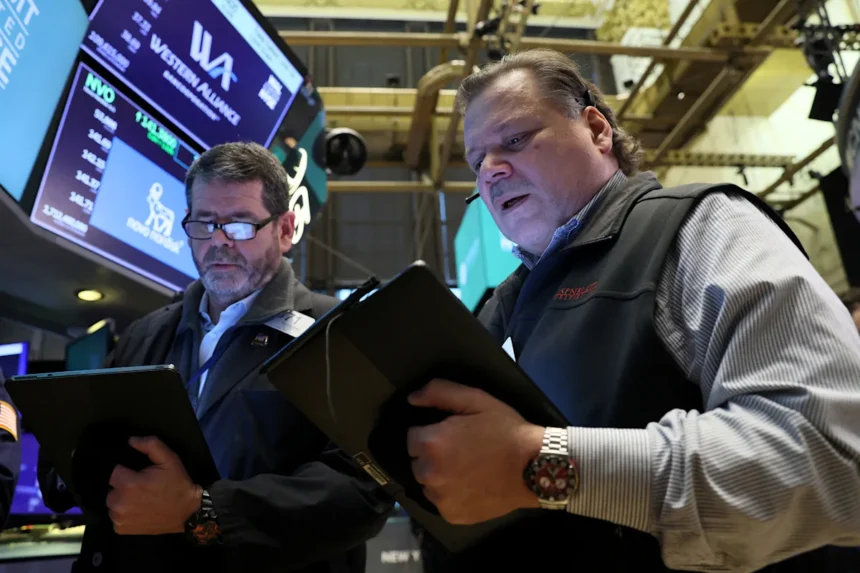
US stock futures experienced a downturn on Friday as market participants braced for potential losses following a broad sell-off. Wall Street is particularly focused on the upcoming consumer inflation data, which could offer vital insights into the trajectory of interest rates. Contracts associated with both the S&P 500 and Dow Jones Industrial Average futures dipped approximately 0.4%, while Nasdaq 100 futures recorded a slightly smaller decline of 0.3%. This signals a resurgence of pressure within the technology sector.
Investor caution is palpable after a tumultuous day of trading, fueled by fears concerning the impact of artificial intelligence (AI) on various industries, including real estate, logistics, and transportation—areas previously regarded as stable alternatives to technology stocks. The tech giants, dubbed the “Magnificent Seven,” faced significant losses, with all seven companies closing lower on the day.
The market’s anxiety is exacerbated as investors await crucial earnings reports, which could provoke further volatility. Applied Materials saw a notable surge, with its stock climbing over 10% as the chip equipment manufacturer reported a positive outlook driven by strong AI demand. In contrast, Pinterest shares plunged nearly 20%, following a disappointing revenue report that raised concerns about AI’s threat to its advertising model.
Attention is also turned towards the anticipated report on the consumer price index (CPI), a primary inflation measure that is closely watched by the Federal Reserve. This data is expected to provide clarity on whether inflation pressures are diminishing as 2026 begins. Current projections estimate an annual CPI rate decrease to around 2.5%. Any deviation from predictions could significantly influence expectations regarding the Federal Reserve’s interest rate policies.
On the earnings front, Rivian’s stock jumped by almost 20% after the electric vehicle (EV) manufacturer reported stronger-than-expected results for its fourth quarter. The company confirmed that deliveries of its R2 midsize model are on track for summer launch. Meanwhile, Moderna’s report, which follows a recent drop in its share value due to the FDA rejecting a new flu vaccine, is also on investor radars.
In premarket trading, several companies are attracting attention. DraftKings saw a premarket drop of 17% following its failure to meet analyst expectations for the upcoming year as it invests heavily in prediction markets. Conversely, Roku’s stock rose by 15% after the streaming platform exceeded earnings expectations and provided robust guidance for the year. Instacart, also known as Maplebear, saw its stock rise by 12% after beating revenue projections, although its fourth quarter results were impacted by a hefty $60 million Federal Trade Commission settlement over pricing practices.
On an international scale, Wall Street’s trepidation regarding AI disruption is seemingly benefiting Asian markets, particularly in the semiconductor sector. The MSCI Asia Pacific Index has risen by over 12% in 2026, contrasting with the declines seen in US markets where concerns about AI’s implications have led to sell-offs, particularly among tech stocks. Analysts suggest that the shift in investor preference toward hardware producers in Asia, like Samsung and Taiwan Semiconductor Manufacturing Co., is strengthening the region’s stock performance. As Richard Tang from Julius Baer noted, despite uncertainties to come, the upstream technology suppliers in Asia are expected to maintain revenue irrespective of how AI developments unfold downstream.