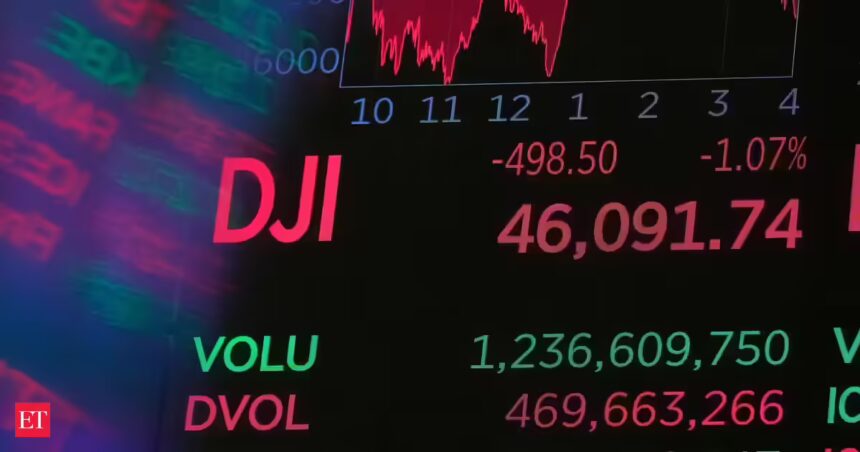
The U.S. stock market experienced a significant crash today, causing turmoil throughout Wall Street. The Dow Jones Industrial Average fell by 234 points, ending at 45,787.01. The S&P 500 saw a decline of 0.85%, closing at 6,550.12, while the Nasdaq plummeted by 1.26%, settling at 21,812.80. This swift market downturn sent investors scrambling into safer assets as fears over rising geopolitical tensions intensified.
The immediate catalyst for the sell-off can be traced back to escalating conflicts in the Middle East, specifically overnight strikes between Iran and Israel. This development triggered a marked increase in uncertainty, which analysts point out is anathema to investor confidence. Compounding matters was the report of the U.S. deploying additional Marines to the region, raising concerns of a potential prolonged conflict. Historically, such heightened risks have negatively impacted equity markets, prompting investors to pull back from stocks in favor of safer options.
Adding to the market’s distress, attacks on energy infrastructure in the Gulf raised fears of supply disruptions. Although oil prices did not experience a dramatic spike, the underlying risks are palpable enough to influence market behavior. The combined effects of geopolitical uncertainty and instability in energy markets were reflected in the significant sell-offs across various sectors.
As the market reacted, intraday losses in the Dow exceeded 279 points, highlighting the sustained selling pressure. The S&P 500’s decline of 56.37 points, though appearing moderate, was significant in a high-valued market, indicating widespread weakness across multiple sectors. The Nasdaq’s drop of 277.89 points further underscored the vulnerability of technology stocks in the face of uncertainty.
In contrast to the broader market decline, some stocks experienced notable gains. AleAnna, Inc. Class A led the way with a remarkable increase of 79.42%, closing at $6.80. Planet Labs PBC followed suit with a gain of 28.12%, ending at $34.54. AT&T Inc. also saw a rise of 2.72%, closing at $28.50, supported by solid trading volume.
On the other hand, the day’s losses included Super Micro Computer, Inc., which plummeted by 27.64% to $22.28, indicating significant selling pressure. Other notable decliners included Ondas Holdings Inc., which dropped 5.63%, and Co-Diagnostics, Inc., which fell 2.08%. Major tech players like NVIDIA and Tesla also faced challenges, reflecting a broader trend of weakness in the tech sector.
The energy markets played a pivotal role in the market’s downturn today. WTI crude prices saw a slight increase to $96.01, while Brent crude remained relatively stable at $108.60. However, Murban crude surged by an alarming 14.18% to $141.70, reflecting heightened tensions in oil markets. Contrarily, natural gas prices slid by 3.38% to $3.059, presenting mixed signals in the energy sector. This volatility complicates predictions regarding inflation trends, contributing further to market uncertainty.
Bond yields also surged, with UK yields surpassing 5%, levels not seen since the 2008 financial crisis. Higher yields translate into increased borrowing costs, which directly impacts stock valuations and often prompts investors to shift their focus away from equities to bonds.
Despite the prevailing downturn, not every stock moved downward. Chevron, for instance, benefitted from an upgrade to a “buy” rating from HSBC, coupled with a price target increase to $215, as analysts noted its relative safety from ongoing geopolitical tensions. Similarly, FedEx saw its stock rise by over 7% following strong earnings reports, receiving a bullish endorsement from Bank of America.
Looking ahead, investors face uncertainty regarding the market’s direction following this crash. If geopolitical tensions continue, further downside may be likely as the potential for rising oil prices and slower global growth could weigh heavily on stocks. Conversely, should the situation stabilize, historical trends suggest that markets may rebound quickly after geopolitical sell-offs. The coming days will be crucial in determining the longer-term impacts of today’s market events on investor sentiment and stock valuations.