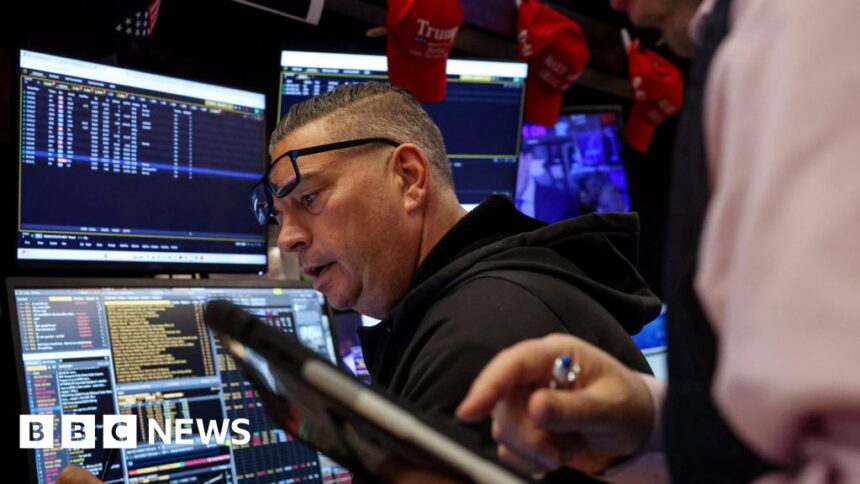
The three major U.S. stock indexes experienced a notable downturn on Thursday, reversing an earlier morning rally. Initially buoyed by positive business developments, including strong performances from tech giant Nvidia and retail leader Walmart, markets ultimately succumbed to investor anxiety that has characterized recent weeks.
In detail, the S&P 500 saw a decrease of 1.6%, the Dow Jones Industrial Average fell by 0.8%, and the Nasdaq ended the day down over 2%. Nvidia’s shares, which had gained momentum during Thursday’s early trading, were reported to have dropped more than 3% by the closing bell.
James Stanley, a senior analyst at StoneX, highlighted the initial optimism and the subsequent market shift, noting, “The reaction is noteworthy, because what should have happened, didn’t happen.” He called into question underlying factors driving the market’s performance.
Compounding the downturn, Bitcoin prices fell below $90,000, marking its lowest point since April. Analysts pointed to burgeoning concerns over the valuations of AI companies as a contributing factor to this decline. Despite a robust report from Nvidia regarding its AI chip sales, fears of an impending AI bubble lingered. Chief Executive Jensen Huang attempted to alleviate such concerns during a call with analysts, asserting, “From our vantage point, we see something very different.”
Financial analysts maintain a cautious outlook. Although Huang’s reassurances and Nvidia’s impressive earnings did elevate stocks temporarily, investor apprehension persists. Alphabet CEO Sundar Pichai recently commented on “irrationality” surrounding the current AI wave, while analysts from Oxford Economics suggested that the recent technology sector downturn may represent a necessary correction, rather than a precursor to more troubling trends. Their insight implied that, while profit-taking might be on the horizon for tech stocks, it is premature to declare the end of the AI investment surge.
As interest rates become a growing concern, investors are eagerly anticipating key inflation data that has been delayed due to a U.S. government shutdown. This information is crucial for evaluating the Federal Reserve’s potential monetary policy actions in the coming months.
The S&P 500 index currently sits over 4% lower for November, positioning it for its worst monthly performance since March. Stanley commented on investor behavior, noting the tendency to “square up” amidst economic uncertainty and potential Fed interest rate hikes if inflation remains elevated. He remarked, “There’s a lot of trepidation about where inflation is. There’s a lot of opacity.”
The latest jobs report added to the ambiguity surrounding the Fed’s monetary policy decisions. The Labor Department reported an addition of 119,000 jobs for September—more than double analysts’ predictions—but the unemployment rate edged up from 4.3% to 4.4%. This mixed data leaves investors questioning whether the Fed will enact rate cuts during its next meeting in December.
Eric Teal, the chief investment officer at Comerica Bank, emphasized the importance of sustained AI growth and lower interest rates as necessary conditions for enabling further stock market gains. However, he warned that the current climate of uncertainty regarding the AI sector and inflation could result in heightened market volatility.
He noted, “When you have a market that’s priced at perfection, you need all of the external catalysts behind it to keep driving it higher. A lot of those things, over the past three weeks, have been called into question.”